More like First Cycle
anchored on:science fictionfirst contactaliensother star systemsfar futurewar
but
- Armor
John Steakleystandalone novel1984
similar bydarkother star systemsfar futurealienswarscience fiction
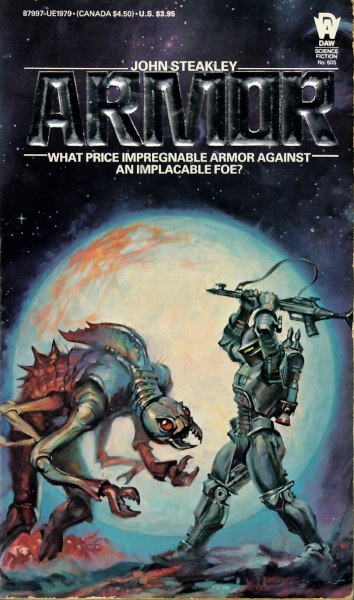
Armor is a military science fiction novel by John Steakley. It features the military use of exoskeletons and insect-like alien enemies but concentrates on the psychological effects of violence on human beings.
- The Dosadi Experiment
Frank Herbertstandalone novel1977
similar byother star systemsfar futurealiensscience fiction+1 more
From the flaps of the Berkley Putnam first edition: "In his first new work of science fiction since the best-selling Children of Dune, Frank Herbert returns to his world of Whipping Star, and involves Jorj X. McKie, Saboteur Extraordinary, in a new intrigue. In Whipping Star, McKie discovered that some of the stars in the universe are actually intelligent, super-powerful beings, and was able to befriend one of them, the star Alcyone - affectionately known as Fannie Mae. As The Dosadi Experiment opens, McKie is assigned to investigate the planet Dosadi, which is isolated from the rest of the galaxy by a "god-wall," a barrier set up by one of the intelligent stars. Dosadi is rumored to be an experimental planet, and the experimenters are the froglike Gowachin, whose culture is founded upon a strange legal system in which McKie is the only human ever trained. He learns that humans and Gowachin have been placed on Dosadi, without their consent, for an experiment that could last centuries: an experiment in extreme overcrowding. But this monstrous plot is apparently out of control, and it seems the Gowachin may be prepared to destroy Dosadi rather than expose its secret, thus breaking the peace among the races, and starting the first interstellar war. But this is just the beginning. When McKie finally reaches Dosadi he discovers that the Dosadis have taken control of their own evolution and produced a competitive, highly evolved elite, of both humans and Gowachin, who have been able to extrapolate the existence of a universe beyond the god-wall and hate whoever has imprisoned them like this. They plan to break out and avenge themselves on the galaxy."
- Heritage of Flight
Susan Shwartzstandalone novel1989
similar bydarkother star systemsfar futurealienswarscience fiction+1 more
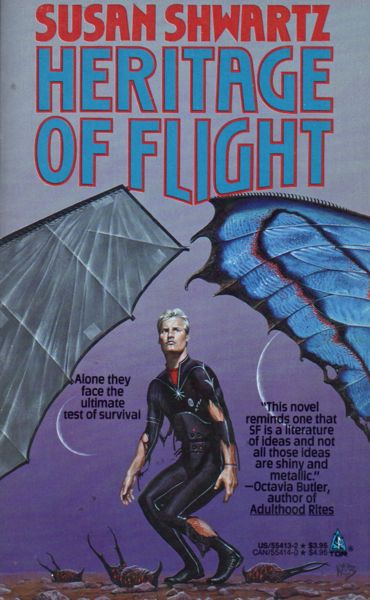
From the back cover of the Tor first edition: "Pauli Yeager knew how to survive in deep space; as senior fighter pilot for the battleship Amherst she had logged years of combat experience. But she knew she wasn't prepared for the new command. Project Seedcorn was the last hope of an ambitious race. Humanity was embroiled in a planet-slagging war that promised a fast and final death. The small group of refugees hidden on the fringe of human-occupied space was ordered to live and be human. THe initial survey had shown no life on Cynthia, but there was life, intelligent life... huge graceful creatures with iridescent wings. They filled the sky with splendor and covered the ground with a legacy of horror. The simple command, live and be human, became an epitaph. Survival depended on the children - human and Cynthian - and Paul had to convince her people to commit a heinous crime or watch their children die..."
- Clans of the Alphane Moon
Philip K. Dickstandalone novel1964
similar byother star systemsfar futurealiensscience fiction+1 more
Clans of the Alphane Moon is a 1964 science fiction novel by American writer Philip K. Dick. It is based on his 1954 short story "Shell Game", first published in Galaxy Science Fiction magazine.
- Hunter's Run
Gardner Dozois, George R. R. Martin & Daniel Abrahamstandalone novel2007
similar byaliensother star systemsfar futurescience fiction+1 more
Hunter's Run is a 2007 science fiction novel written by Daniel Abraham, Gardner Dozois and George R. R. Martin. It is a heavily rewritten and expanded version of an earlier novella called Shadow Twin.
- Dune
series20 books1963
part of Dune Universe
similar byfar futureother star systemsscience fiction+1 more
Frank Herbert's Dune Chronicles opens with 1965's Dune, set on the desert planet Arrakis where House Atreides takes control of the only source of the vital spice melange and young Paul Atreides is pulled into a struggle over its politics and religion. Herbert carried the story forward across five further novels — Dune Messiah, Children of Dune, God Emperor of Dune, Heretics of Dune, and Chapterhouse: Dune — following Paul's line over the following millennia, before Brian Herbert and Kevin J. Anderson later extended the saga. Many other editions of these six novels are omnibus and box-set repackagings rather than separate stories.
- Xenogenesis / Lilith's Brood
series4 books1987
completed
similar byaliensscience fictionfar futurefirst contact+2 more
Lilith's Brood, previously known as the Xenogenesis Trilogy, is a collection of three science fiction works by Octavia E. Butler: Dawn, Adulthood Rites, and Imago.
- Humanity Prime
Bruce McAllisterstandalone novel1971
similar byaliensother star systemsfar futurewarscience fiction+1 more
When Man's emerging star-empire met that of the savage Cromanths, the alien hordes began a war of extinction against humankind. So overwhelming was their power that Earth's outposts and finally the Earth itself were utterly destroyed. But one starship managed to escape, carrying colonists for some distant Earthlike planet... if such a place existed... and if the Cromanths didn't find the human colony. The mission was successful and the colony established. Mankind began to adapt to its new world, developed new abilities, and forgot much of the past. But then a Cromanth ship landed on the new planet- the last remnants of humanity were discovered. Could they somehow survive a new onslaught by the Cromanth Empire? (adapted from the back cover of the first edition)
- Moties
series4 books1974
part of CoDominium
similar byfar futureother star systemsaliensscience fictionfirst contact+1 more
Larry Niven and Jerry Pournelle's The Mote in God's Eye (1974) depicts humanity's first contact with an alien species, the Moties, set within the far-future interstellar setting of Pournelle's codominium future history. The Gripping Hand continues that first-contact crisis years later, and Outies, written by J. R. Pournelle, carries the story forward into a new generation. Together the three books trace an escalating encounter between human and Motie civilizations within the codominium universe.
- Forever War
series10 books1972
similar byscience fictionfar future+3 more
Joe Haldeman's The Forever War (1974) follows a soldier conscripted into a centuries-long interstellar war against the alien Taurans, using relativistic space travel so that months spent in transit correspond to years or decades passing back on Earth. Haldeman later returned to the same conflict in Forever Peace (1997), a thematically connected but separate story, and Forever Free (1999), a direct sequel set years after the original war's end. The first novel won the Hugo, Nebula, and Locus awards and is considered a foundational work of military science fiction.
- Conquerors
series3 books1994
similar byaliensother star systemsfar futurewarscience fictionfirst contact
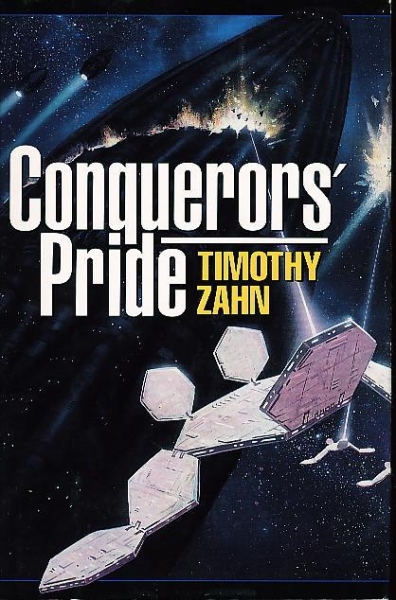
Conquerors is Timothy Zahn's military science-fiction trilogy following human fighter pilots and their commanders through an interstellar war that neither side fully understands, told across Conquerors' Pride, Conquerors' Heritage, and Conquerors' Legacy. Zahn alternates perspective between the human and alien chains of command, using the shifting viewpoints to slowly unpick why the conflict started in the first place. It's contact-and-conflict SF built around miscommunication rather than straightforward invasion.
- Rise of the Jain
series3 books2018
part of Polity
similar byfar futurealienswarother star systemsscience fiction+1 more
- Thorns
Robert Silverbergstandalone novel1967
similar bydarkfar futurealiensscience fictionother star systems
From the back cover of the Ballantine first edition: "Lona Kelvin - naive orphan. And at seventeen, mother of one hundred children. Minner Burris - starman. Whose butchered body had been put together by aliens, with artificial and alien replacements. Horror stalked just beneath the surface of these two lonely creatures. Duncan Chalk - a vulture, carrion eater of other people's emotions, feeding on pain, fear, anger, hatred, jealousy, terror; typifying in the appetites of his vast body the sick delight that millions took in the tragedies he skillfully arranged. Lona Kelvin - Minner Burris - Duncan Chalk - Surely the strangest triangle the worlds had ever seen."
- Berserker (Fred Saberhagen)
series59 books1963
similar byfar futurescience fictionother star systemswar+1 more
The Berserker series is a series of space opera science fiction short stories and novels by Fred Saberhagen, in which robotic self-replicating machines strive to destroy all life.
- West of the Sun
Edgar Pangbornstandalone novel1953
similar byother star systemsfar futurealiensscience fiction+1 more
From the back cover of the Dell first paperback printing: "After eleven years in space the Argo landed... West of the Sun ... on the dangerous planet Lucifer. The crew faced and untamed world of huge carnivorous birds with wolverine heads and flashing black teeth; furred, ten-foot tall men; red-skinned man-eating pygmies. They fought for mere survival but - their duty was to colonize and populate the planet - four men and only two women."
- Ender Wiggin
series14 books1977
part of Ender's Game Universe
similar byfar futurealiensscience fictionother star systems
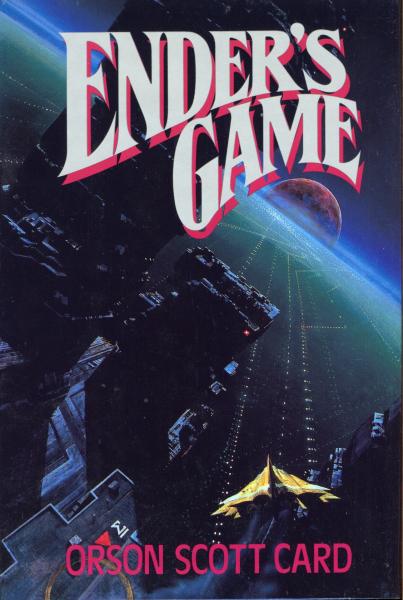
Orson Scott Card's Ender's Game (1985, expanded from his 1977 novella) follows child prodigy Andrew "Ender" Wiggin as he is recruited into a military training program built to prepare Earth's defenses for an anticipated third war against an insectoid alien species known as the Formics. The saga continues years later through Speaker for the Dead and Xenocide, following an older Ender as he confronts the moral weight of his role in that earlier conflict, and concludes the core arc in Children of the Mind, with Ender in Exile filling in the years between the first two books. Set within the wider Ender's Game universe, the series shifts from military coming-of-age story to slower, more philosophical science fiction as it progresses.
- The Madness Season
C. S. Friedmanstandalone novel1990
similar byaliensother star systemsfar futurescience fiction+1 more
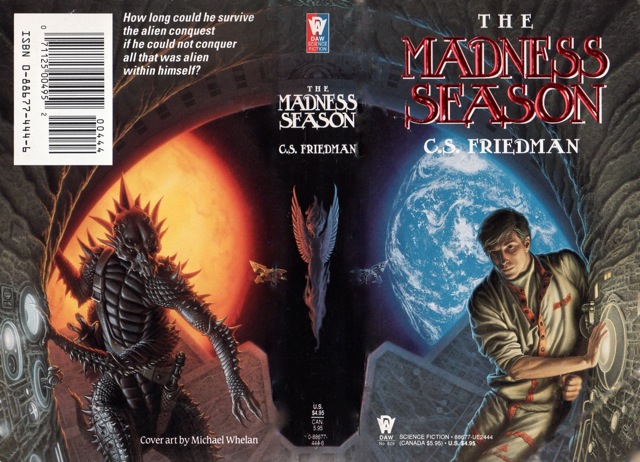
The alien within - He'd had so many names over the centuries, so many new identities that he could scarcely remember who he had originally been. Now his name was Daetrin, a name given by the alien conquerors of humankind, the Tyr. Three hundred years had passed since the Tyr conquered the people of Earth as they had previously overcome numerous races throughout the galaxy. In their victory they had taken the very heart out of the human race, isolating the true individualists, the geniuses, all the people who represented the hopes, dreams, and discoveries of the future, and imprisoning them in dome colonies on planets hostile to human life. There the Tyr, a race which itself shared a unified gestalt mind, had left these gifted individuals to work on projects which would, the conquerors hoped, reveal all of human kind's secrets to them. Yet Daetrin's secret was one no scientist had ever uncovered, for down through the years he had succeeded in burying it so well that he had even hidden his real nature from himself. But, taken into custody by the Tyr, there was no longer any place left for Daetrin to run, no new name and life for him to assume. Now he would at last be forced to confront the truth about himself - and if he failed, not just Daetrin but all humans would pay the price... (from the first page of the DAW Books first edition)
- Forge of God
series2 books1987
completed
similar bydarkaliensscience fiction+3 more
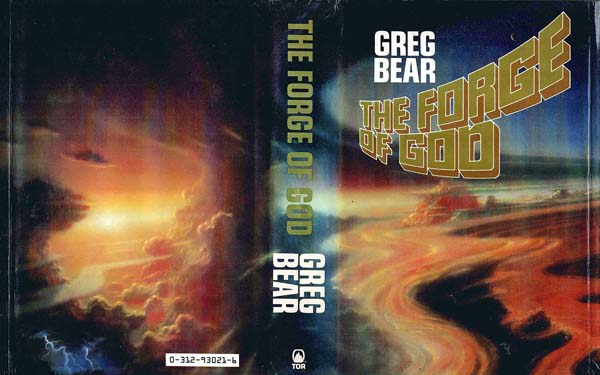
The Forge of God (1987) is Greg Bear's science fiction novel about Earth's discovery that it is the target of an incomprehensible, overwhelming alien attack, following scientists and ordinary people as they try to understand what is destroying the planet. Its 1992 sequel, Anvil of Stars, follows a group of young survivors sent on a mission of interstellar retaliation, continuing directly from the first book's ending.
- The Karma Corps
Neal Barrett & Jr.standalone novel1984
similar byaliensother star systemsfar futurewarscience fiction+1 more
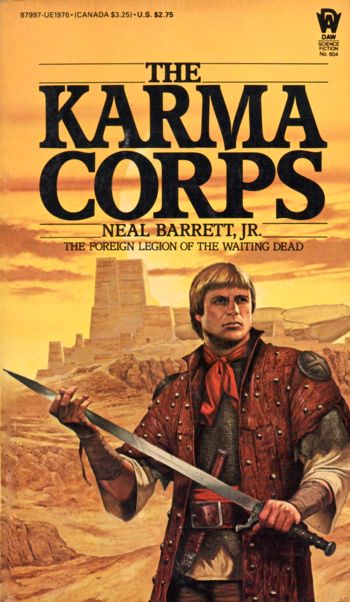
From the back cover of the DAW first edition: "Captain Lars Haggart was a soul waiting to be reborn...but before that blessed event he had been inducted into the Arm of God Regiment, fighting for the beleaguered Churchers on a newly colonized planet. Their foe—demons who could pop into existence, slay and pop out of existence the next instant. The demons were winning that war, sending their Unborn, opponents back to limbo, driving the living colonists toward extermination. But this was no fantasy, no business of the religious imagination. The fight was real, blood was blood, and swords cut sharp, for the Unborn were very much alive. Haggart was aware that this was frighteningly contradictory, but first he had to fight the demons on their own terms, learn how to appear behind their lines and do to them what they were doing to the humans. An unusual science fiction novel of a space colony in deepest trouble and of aliens who knew planetary secrets that were never in anyone's Holy Book."
- Embedded
Dan Abnettstandalone novel2011
similar byother star systemsfar futurewarscience fiction+1 more
The colony planet of Eighty-Six looks as dull as all its fellow new worlds to veteran journalist Lex Falk. But when a local squabble turns violent, and the media get the runaround from the military high command, his interest is seriously piqued. Forbidden from approaching the battlezone, Falk gets himself chipped inside the head of a combat veteran - and uncovers the story of a lifetime.
- Dune Universe
universe78 books1963
Start hereDune · Start here
similar byfar futureother star systemsscience fiction+1 more
Arrakis. Dune. The desert planet, where empire runs on a single substance: the spice melange, which folds space, prolongs life, and unlocks prescience, and which exists nowhere else in the known universe. Frank Herbert's saga is a meditation dressed as an adventure — feudal houses and a secret sisterhood, engineered messiahs and the patient ecology of a world without water, all turning on the terrible gravity of who commands the spice. It reads like scripture and schemes like a war room, ten thousand years hence, among people who have outlawed the thinking machine and made instruments of themselves instead. At its heart stand Herbert's original six — Dune, Dune Messiah, Children of Dune, God Emperor of Dune, Heretics of Dune, Chapterhouse: Dune — a single deepening arc across millennia, arguing the whole way between prophecy and free will. Around that spine his son Brian Herbert and Kevin J. Anderson have raised a vast prequel architecture: Prelude to Dune, tracing the great houses a generation before Paul; Legends of Dune, reaching back to the crusade that broke the machines; the Schools of Dune cycle on the founding of Bene Gesserit, Mentat, and Navigator; the Caladan Trilogy and Heroes of Dune filling years the originals left in shadow. Many hands, dozens of volumes, one desert. What sets Dune apart is its refusal of the simple: religion is manufactured, heroes are hazards, and the sand itself — worm, water, ecology — acts as a political power. Begin where the universe did, with Frank Herbert's Dune (1965), and read the original six in order; you need nothing else to feel the full weight. The prequels are a country to explore afterward, taken by era. Beginnings are delicate times.
- Sun Eater
series36 books2018
similar bydarkfar futurewarscience fiction+2 more
The Sun Eater is a science fiction novel series written by American author Christopher Ruocchio. Not including short stories and novellas, the series consists of the following novels: Empire of Silence (2018), Howling Dark (2019), Demon in White (2020), Kingdoms of Death (2022), Ashes of Man (2022), Disquiet Gods (2024), and Shadows Upon Time (2025).