More like Hellflower
anchored on:science fictionother star systemsfar futureadventurousspace operaartificial intelligence+4 more
but
- Fifth Imperium
series3 books1991
similar byfar futurescience fictionadventurousartificial intelligencealiensspace operatensespace+1 more
David Weber's Fifth Imperium series opens with the discovery that Earth's Moon is in fact a disguised alien starship, the Dahak, that has orbited undetected for tens of thousands of years - a relic of the fallen Fourth Imperium, a multi-star civilization destroyed while defending against the genocidal Achuultani. Mutineers' Moon follows humanity's first contact with Dahak and the mutineers still aboard it; The Armageddon Inheritance and Heirs of Empire escalate from that discovery into interstellar war and dynastic politics as humanity inherits the old empire's legacy and its enemies. The three novels were later collected as the omnibus Empire from the Ashes.
- Chanur
series7 books1982
part of Alliance-Union Universe
similar byfar futurealiensscience fictionspace operaadventuroustenseother star systemsspace+1 more
The Chanur novels are a series of five science fiction novels, forming three separate stories, written by American author C. J. Cherryh and published by DAW Books between 1982 and 1992. The first novel in the series is The Pride of Chanur (1982), which was nominated for both the Hugo and Locus Awards in 1983. The Pride of Chanur, originally a stand-alone story, was followed by the Chanur's Venture trilogy, Chanur's Venture (1984), which was shortlisted for a Locus Award in 1985; The Kif Strike Back (1985) and Chanur's Homecoming (1986). These were followed by a later sequel, Chanur's Legacy (1992). The five novels were also published in two omnibus editions: the first three in The Chanur Saga in 2000 and the next two in Chanur's Endgame in 2007.
- Ian Cormac
series6 books2001
part of Polity
similar byfar futureartificial intelligencescience fictionspace operatenseother star systemsspace+2 more
Neal Asher's Ian Cormac novels (Gridlinked, The Line of Polity, Brass Man, Polity Agent, Line War, plus the earlier-set prequel Shadow of the Scorpion) follow Ian Cormac, an agent of Earth Central Security in Asher's Polity universe. Gridlinked opens with Cormac investigating a destroyed matter-transmitter on a remote colony while wrestling with the personality erosion caused by long-term neural linkage to the Polity's AI network; the following novels escalate into interstellar conflict with the alien Prador. Together they form the core action sequence of Asher's wider Polity series.
- Moties
series4 books1974
part of CoDominium
similar byfar futurealiensscience fictionspace operaother star systemsspace+2 more
Larry Niven and Jerry Pournelle's The Mote in God's Eye (1974) depicts humanity's first contact with an alien species, the Moties, set within the far-future interstellar setting of Pournelle's codominium future history. The Gripping Hand continues that first-contact crisis years later, and Outies, written by J. R. Pournelle, carries the story forward into a new generation. Together the three books trace an escalating encounter between human and Motie civilizations within the codominium universe.
- Ringworld
series5 books1970
part of Known Space
similar byfar futurealiensscience fictionspace operaadventurousother star systemsspace
The Ringworld series is a series of science fiction novels written by American author Larry Niven. It is part of his Known Space series of stories. Its backdrop is the Ringworld, a giant artifact 3 million times the surface area of Earth circling a star. The series is composed of four standalone science fiction novels, the original award-winning book and its three sequels:1970: Ringworld 1979: The Ringworld Engineers 1996: The Ringworld Throne 2004: Ringworld's Children
- Space Beagle
series5 books1939
completed
similar byfar futurealiensscience fictionadventuroustensespace operaspacespaceship
The Voyage of the Space Beagle is a 1950 fix-up novel by A. E. van Vogt, stitched together from four previously published pulp stories into a single continuous account of the exploration ship Space Beagle's encounters with a series of dangerous alien life forms. Its episodic, crew-versus-monster structure reads as a loose sequence of adventures rather than one continuous plot.
- Wolfling
Gordon R. Dicksonstandalone novel1969
similar byfar futurealiensscience fictionadventurousspace operatenseother star systemsspace
From the flaps of the Baen/SFBC edition: "Is Earth merely the lost colony of a superior race? - She was well over six feet tall, and beautiful in a sculpted, abstract way. She had skin the color of white onyx, and her eyes... her eyes were large and feline - a startling lemon yellow in color. She was the Princess Afuan, one of the High-born, and she had chosen the Earthman Kim Keil to return to the Throne World with her - for she had decided that his performance in the bull-ring might amuse the Emperor. She didn't know that Jim was a bull-fighter only by virtue of six months' intensive training, nor that the bull was programmed - his behavior following and impressively fierce but unswerving pattern. Jim was just another wolfling to Afuan - a lesser being from a backward colony world. Jim, however, was keenly aware that he was playing a role, one which might prove to be extremely dangerous. Up until 10 years earlier, when their first ship had reached Alpha Centauri, the people of Earth hadn't even known that the vast Empire of human-occupied worlds existed. The discovery had been a profound shock. Had we evolved independently? Or were we merely descendants of the Empire's first space pioneers - a lost colony found at last, perhaps with devastating consequences? That's what Jim Keil had to find out. Chosen from among numerous highly qualified candidates - an anthropologist trained, mentally and physically, beyond the limits of his profession - it was his mission to observe the Throne World and the High-born... to determine whether or not they posed a threat to Earth. One thing was apparent from the start. The High-born were superior beings - physically taller and stronger than other humans, endowed with faster reflexes, superior mental capacity... and extraordinary technological resources. Their contempt for the new wolfling in their midst was open, their intrigues complex. An enormous gulf separated the people of the Throne World from Earthlings. But that gulf was not so wide that Jim couldn't recognize an enemy when he met one. Clearly, if he remained merely a passive observer of the High-born, he'd never survive among them."
- Pip & Flinx
series18 books1972
part of Humanx Commonwealth
similar byfar futurescience fictionaliensadventurousspace operaother star systemsspace
The Pip & Flinx novels follow Flinx, a young man with an unusual, mysterious origin, and his ever-present animal companion Pip, across Alan Dean Foster's Humanx Commonwealth setting. Beginning with The Tar-Aiym Krang (1972) — chronologically the second entry, since Foster later filled in Flinx's earlier life — the series grew to fifteen novels published between 1972 and 2017, mixing planetary adventure with a slowly unfolding personal mystery.
- Reclamation
Sarah Zettelstandalone novel1996
similar byfar futureartificial intelligencealiensscience fictionadventuroustenseother star systemsspace+1 more
From the back cover of the Warner first edition: "Heretic priest turned data pirate, Eric Born has run from his past for years. Then his steady clients—a self-proclaimed master race called the Vitae—kidnap a mysterious pariah named Arla Stone from the Realm of the Nameless, the shattered, pre-technological planet Eric fled long ago. Priest and peasant plunge into a mystery mixing myth, genetics, artifacts, aliens, AIs, slavery, and Reclamation. Now Eric is on the run from his own masters, and even his telekinetic abilities and Arla's wits may not be enough to save them..."
- Uplift Universe
universe13 books1980
Start hereUplift · Start here
similar byfar futurescience fictionaliensspace operaadventurousother star systemsspace+1 more
No species, the Galactics insist, ever climbs to sapience alone. For a billion years the elder races have "uplifted" their chosen clients — reshaping some promising animal, gene by patient gene, into a thinking being, then binding it through long ages of indenture. Patron lifts client; client one day becomes patron; and every lineage traces back through the vast Galactic Library to the vanished Progenitors who began it all. Then a ragged band of primates arrives at the stars with no patron to claim them — wolflings, self-made, an affront to a hundred thousand years of law — and worse, these humans have already started uplifting neighbors of their own: the neo-dolphins and neo-chimpanzees of Earthclan. David Brin builds this galaxy across two trilogies. The first — Sundiver, the Hugo- and Nebula-winning Startide Rising, and the Hugo-winning The Uplift War — sends an expedition into the Sun, then follows the dolphin-crewed survey ship Streaker as it flees a discovery that sets fanatical star-clans at war, and a chimp-led resistance on an invaded colony world. The second sequence, Uplift Storm — Brightness Reef, Infinity's Shore, Heaven's Reach — descends to Jijo, a forbidden world where six fallen races hide as illegal settlers, and draws every loose thread toward a reckoning. Short fiction fills the margins. This is space opera with an ecologist's conscience: teeming with invented biologies, wry cross-species banter, and real unease about what we owe the minds we make. Begin with Startide Rising — the saga's beating heart, and readable on its own — or take Sundiver first and read straight through in publication order.
- Legion of Space
series7 books1947
completed
similar byfar futurealiensscience fictionadventurousspace operaspaceother star systems+1 more
The Legion of Space is a space opera science fiction series by American writer Jack Williamson. The story takes place in an era when humans have colonized the Solar System but dare not go farther, as the first extra-solar expedition to Barnard's Star failed and the survivors came back as babbling, grotesque, diseased madmen. They spoke of a gigantic planet, populated by ferocious animals and the single city left of the evil "Medusae". The Medusae bear a vague resemblance to jellyfish, but are actually elephant-sized, four-eyed, flying beings with hundreds of tentacles. The Medusae cannot speak, and communicate with one another via a microwave code.
- Starman Jones
Robert A. Heinleinstandalone novel1953
similar byfar futurescience fictionadventurousspace operaspacespaceshipother star systems+1 more
Starman Jones, a 1953 science fiction novel by Robert A. Heinlein, features a farm boy who wants to go to the stars. Charles Scribner's Sons published the book as part of the Heinlein juveniles series.
- Mission to Universe
Gordon R. Dicksonstandalone novel1965
similar byfar futurealiensscience fictionadventurousspace operatensespaceother star systems
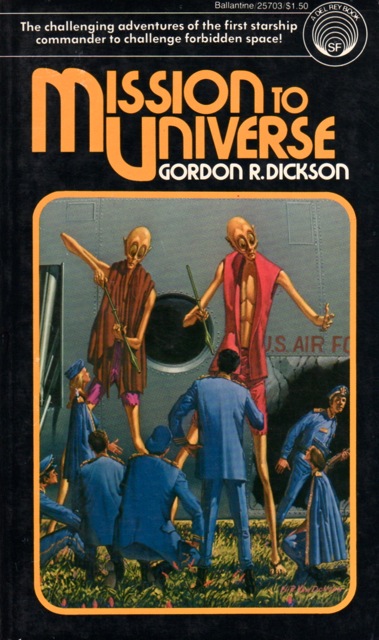
Forever and a day - Brigadier General Benjamin Shore ignores a Presidential command and launches a revolutionary phase ship and its crew on an incredible journey deep into uncharted regions toward Galactic Centerpoint... Investigating one planet after another in search of a habitable world, they encounter: the vicious vine-tigers, weasel-like pre-men, who live on an innocent looking planet lit by the sun of Polaris; the slim Gray-furs, a race possessing fantastic knowledge, yet strangely inept; and the giant conquerers, the Golden People, with their magnificent cities, and their deadly javelin guns... With half his crew lost, General Shore prepares to return to Earth, only to find his most formidable foe aboard the phase ship itself... (from the back cover of the Berkley first edition)
- The Final Architecture
series6 books2021
similar byfar futurealiensscience fictionspace operaadventuroustenseother star systemsspace
The Final Architecture is a series of science fiction novels by British writer Adrian Tchaikovsky. It contains the books Shards of Earth, Eyes of the Void, and Lords of Uncreation. The series focuses on a group of humans fighting against the mysterious Architects, who destroy inhabited planets. The series has been well-received critically, with Shards of Earth winning the 2021 BSFA Award for Best Novel. The entire series was a finalist for the 2024 Hugo Award for Best Series.
- Iris
William Barton & Michael Capobiancostandalone novel1990
similar byfar futureartificial intelligencealiensscience fictionspace operaadventurousspaceother star systems+2 more
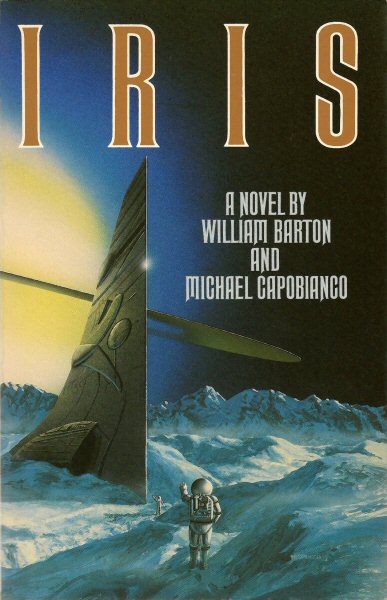
From the front flap of the Doubleday first edition: "From a future Earth ravaged by economic collapse to a rogue planet and its three enigmatic moons, from the familiarity of a colony ship to the heart - and mind - of a totally alien world, William Barton and Michael Capobianco take both the reader and the crew of the Deepstar on a daring odyssey of extraterrestrial exploration and dazzling alien contact. When the gas giant Iris approaches our solar system, the ten-member crew of the Deepstar, originally intending to colonize Titan, decide to change their course and make their new home on Ocypete, one of Iris's moons. It is only when they begin to explore their new surroundings that they discover the Artifact - an ancient alien spacecraft, empty, deserted, but still operational. As the group seeks an explanation for the mysterious ship, they find a frightening new reason to band together when one of their number is suddenly telepathically absorbed by the immense, living alien computer buried at the heart of Iris itself. The discoveries they make - and the battle they must fight - take them on a journey through inner and outer space, through the intricate mazes of the mind and the delicate pathways of the heart."
- Heechee
series19 books1972
completed
similar byfar futurealiensscience fictionspace operaother star systemsspace+1 more
The Heechee Saga, also known as the Gateway series, is a series of science fiction novels and short stories by Frederik Pohl. The Heechee are an advanced alien race that visited the Solar System hundreds of millennia ago and then mysteriously disappeared. They left behind bases containing artifacts, including working starships, which are discovered and exploited by humanity.
- The Winged Man
A. E. van Vogt & E. Mayne Hullstandalone novel1966
similar byfar futurealiensscience fictionadventurousspace operatenseother star systems
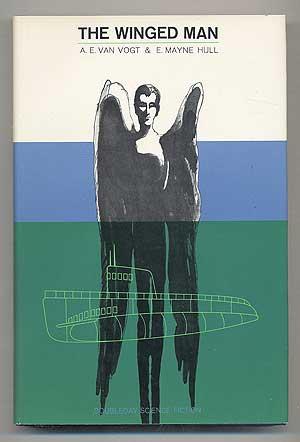
The crew of the submarine Sea Serpent and the submarine itself are taken by a strange winged man to the year 24,999, where a war is going on between the winged men and gigantic fishmen living under the sea. The winged men want the crew of the Sea Serpent to destroy the fishmen with their submarine, the only thing capable of going under water and destroying the city of the fishmen.
- Uplift
series5 books1980
part of Uplift Universe
similar byfar futurescience fictionaliensadventurousspace operaother star systemsspace+1 more
David Brin's Uplift trilogy opens with Sundiver, sending human explorers into the Sun itself, then follows a dolphin-crewed starship on the run from hostile aliens in Startide Rising and a fight over the colony world Garth in The Uplift War. The books sit inside Brin's wider Uplift Universe, built on the idea that spacefaring "patron" species genetically engineer younger "client" species into full sapience, with humanity an anomaly that reached the stars without a patron of its own.
- Commonwealth Saga
series2 books2004
part of Commonwealth Universe
similar byfar futurealiensscience fictionspace operatense+4 more
The Commonwealth Saga is a series of science fiction novels by British science fiction writer Peter F. Hamilton. This saga consists of the novels Pandora's Star (2004) and Judas Unchained (2005). Hamilton has also written several books set in the same literary universe. Misspent Youth (2002) takes place 340 years before the events of Pandora's Star. The Void Trilogy, consisting of The Dreaming Void (2008), The Temporal Void (2009), and The Evolutionary Void (2010), takes place 1,200 years after the events of Judas Unchained; several of the main characters from Judas Unchained and Pandora's Star also appear in the Void trilogy.
- Space Winners
Gordon R. Dicksonstandalone novel1965
similar byfar futurealiensscience fictionadventurousspace operatenseother star systemsspace
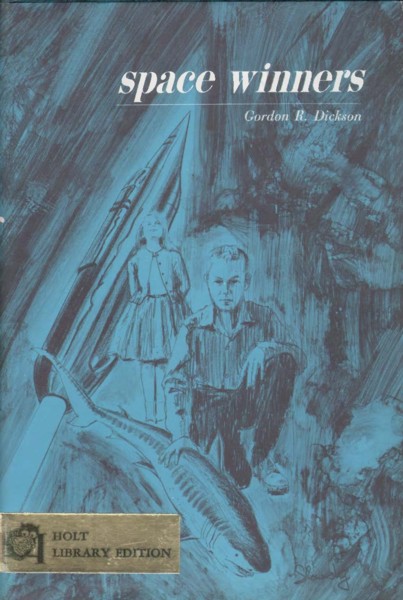
They were humanity's hope - the first young people selected to leave Earth for study in the Galactic Federation. But something went wrong in deep space. Terribly wrong. Suddenly Jim Rawlins, Ellen Bouvier, Curt Harrington, and the squirrel-like Alien philosopher Peep were castaways, stranded on the Quarantined World of Quebahr - with no training, and little hope of rescue. Between them and the Federation's emergency beacon were primitive Mauregs, aggressive Walats, lizard-like Noifs - plus danger, conspiracy, and the mystery of an impending high-tech war on a backward, peaceful planet. Without warning, the future of two worlds - Earth and Quebahr - depended on three young humans' ability to adopt and survive.
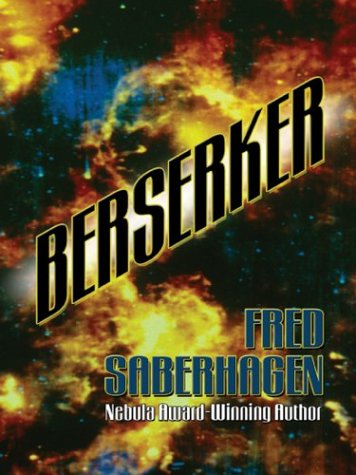
- Berserker (Fred Saberhagen)
series59 books1963
similar byfar futureartificial intelligencescience fictionspace operatensespaceother star systems
The Berserker series is a series of space opera science fiction short stories and novels by Fred Saberhagen, in which robotic self-replicating machines strive to destroy all life.
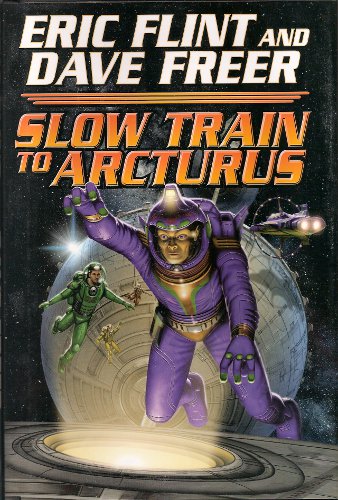
- Slow Train to Arcturus
Eric Flint & Dave Freerstandalone novel2008
similar byfar futurealiensscience fictionspace operaadventuroustensespacespaceship+1 more
Sending a spaceship to rendezvous with an enormous vessel made up of a series of globular habitats approaching its star system, the aliens find a savage race calling themselves "humans" who promptly slaughter the exploration team, except for a single survivor who escapes to another habitat, where he finds more friendly humans whose help he requires to get back to his own ship.
- Catteni Sequence
series5 books1970
completed
similar byfar futurealiensscience fictionadventurousspace operaother star systems+2 more
The Catteni series is a tetralogy of science fiction novels by American writer Anne McCaffrey. In this universe, humans are slaves of aliens, the humanoid Catteni. Woven through all four of the books are details of the relationship between Kristin Bjornsen, a former slave, and Zainal, a renegade Catteni.
- Ender Wiggin
series14 books1977
part of Ender's Game Universe
similar byaliensfar futurescience fictionother star systems+4 more
Orson Scott Card's Ender's Game (1985, expanded from his 1977 novella) follows child prodigy Andrew "Ender" Wiggin as he is recruited into a military training program built to prepare Earth's defenses for an anticipated third war against an insectoid alien species known as the Formics. The saga continues years later through Speaker for the Dead and Xenocide, following an older Ender as he confronts the moral weight of his role in that earlier conflict, and concludes the core arc in Children of the Mind, with Ender in Exile filling in the years between the first two books. Set within the wider Ender's Game universe, the series shifts from military coming-of-age story to slower, more philosophical science fiction as it progresses.