More like Reentry
anchored on:science fictionnear futurefirst contact
but
- Ender Wiggin
series14 books1977
part of Ender's Game Universe
similar byscience fictionaliens+3 more
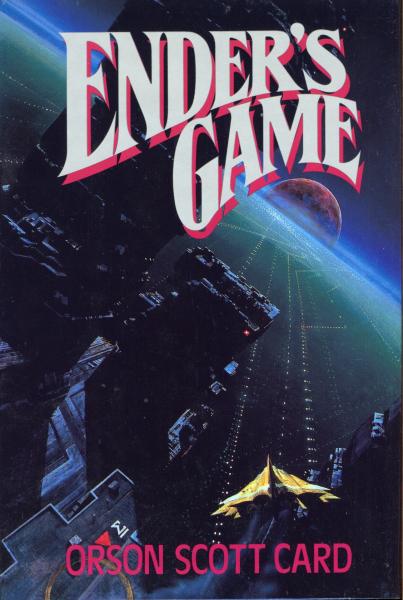
Orson Scott Card's Ender's Game (1985, expanded from his 1977 novella) follows child prodigy Andrew "Ender" Wiggin as he is recruited into a military training program built to prepare Earth's defenses for an anticipated third war against an insectoid alien species known as the Formics. The saga continues years later through Speaker for the Dead and Xenocide, following an older Ender as he confronts the moral weight of his role in that earlier conflict, and concludes the core arc in Children of the Mind, with Ender in Exile filling in the years between the first two books. Set within the wider Ender's Game universe, the series shifts from military coming-of-age story to slower, more philosophical science fiction as it progresses.
- Blindsight / Firefall
series3 books2006
similar bytenseartificial intelligencespacescience fictionfirst contactaliens+2 more
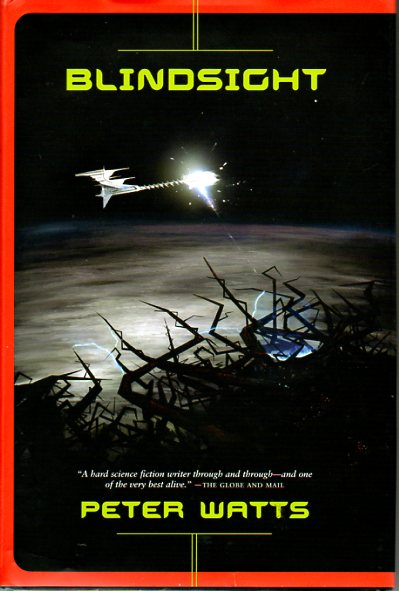
Blindsight sends a crew of radically modified posthumans (including a resurrected, genetically restored vampire) out to the Oort cloud after humanity detects an alien signal, only to make contact with something intelligent, wildly capable, and possibly not conscious at all — a first-contact story built around the question of whether self-awareness is actually useful. Peter Watts's Echopraxia is a same-timeframe "sidequel" rather than a direct sequel, following different characters through the fallout of the same first-contact event.
- Ocean / Galactic Center
series12 books1972
similar byscience fictionaliens+5 more
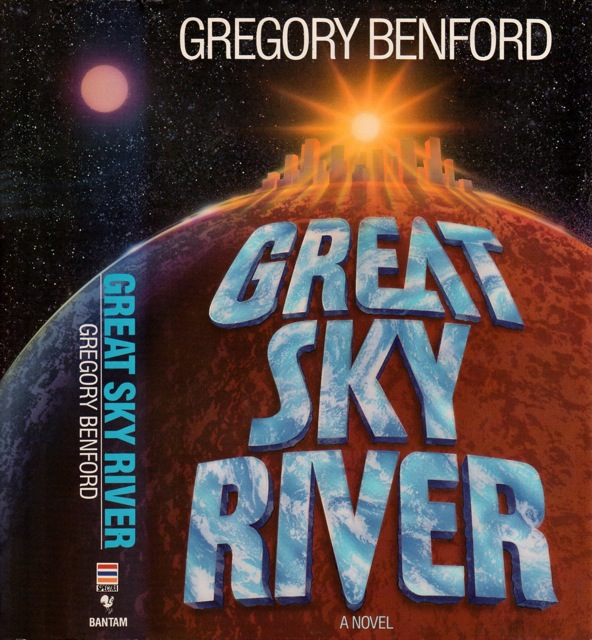
The Galactic Center Saga is a series of books by author Gregory Benford detailing a galactic war between mechanical and biological life.In the Ocean of Night (1977) — 1977 Nebula Award nominee, 1978 Locus Award nominee Across the Sea of Suns (1984) Great Sky River (1987) — 1988 Nebula Nominee Tides of Light (1989) — 1990 Locus Award nominee Furious Gulf (1994) Sailing Bright Eternity (1996) "A Hunger for the Infinite" a novella published in the anthology Far Horizons
- Forge of God
series2 books1987
completed
similar bytensescience fictionaliens+4 more
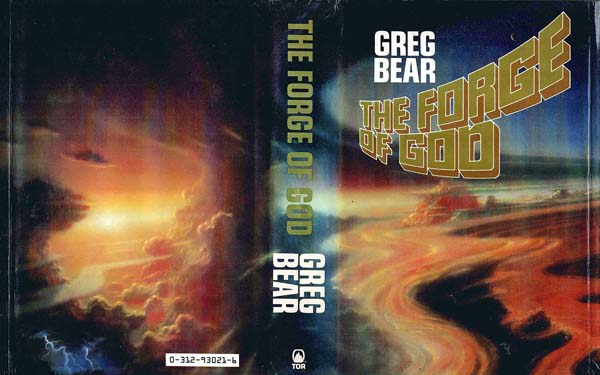
The Forge of God (1987) is Greg Bear's science fiction novel about Earth's discovery that it is the target of an incomprehensible, overwhelming alien attack, following scientists and ordinary people as they try to understand what is destroying the planet. Its 1992 sequel, Anvil of Stars, follows a group of young survivors sent on a mission of interstellar retaliation, continuing directly from the first book's ending.
- Have Space Suit - Will Travel
Robert A. Heinleinstandalone novel1958
similar bytensenear futurespacescience fictionaliensspace exploration+1 more
From the back cover of the Del Rey 9th printing: "Skyjacked - Everything happened at once. One minute Kip Russell was walking about in his own backyard, testing out an old space suit and dreaming about going to the moon - and the next he was out cold and the captive of an insidious space pirate. The whole thing seemed like a very bad dream until he discovered he wasn't the only prisoner on board. Then the reality of the situation became inescapable. He - along with the daughter of a world-renowned scientist and a beautiful creature from an alien planet - had been skyjacked by a monstrous extraterrestrial and they were on their way to the Moon... a journey toward a fate worse than death!"
- Voyagers (Ben Bova)
series4 books1981
completed
similar byscience fictionnear futurefirst contact+4 more
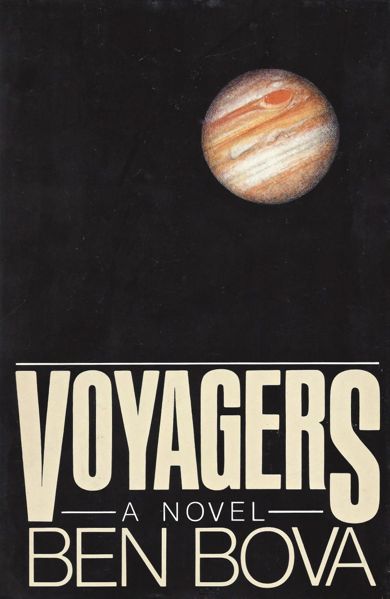
Ben Bova's Voyagers trilogy (Voyagers, 1981; Voyagers II: The Alien Within, 1982; Voyagers III: Star Brothers, 1990) is a space-opera romance built around first contact: a starship crewed by technologically advanced aliens approaches Earth, and the human response entangles politics, cross-species relationships, and advanced alien technology like biochips passed on to the human characters.
- Eater
Gregory Benfordstandalone novel2000
similar bytensenear futurespacescience fictionfirst contactaliens+1 more
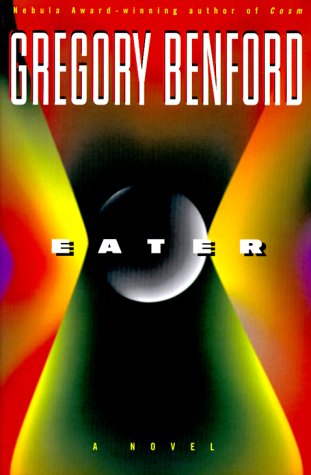
From the flaps of the Eos first edition: "Dr. Benjamin Knowlton heads the High Energy Astrophysics Center, a prestigious research facility devoted to the interpretation of astronomical data. He stands at the apex of his profession, respected by his peers and involved in research with the potential to revolutionize our understanding of the universe. But Benjamin has no cause to celebrate. His beloved wife and colleague, Channing, an ex-astronaut turned astronomer, is dying of cancer. She has only a few months to live. Then an anomalous signal from a remote probe alerts Banjamin to the presence of a wandering black hole beyond the orbit of Pluto. Though its trajectory will take it through the solar system, the singularity poses no threat to Earth-on the contrary, it may hold answers to the most fundamental questions of physics. But when an encoded message is received from the black hole, excitement turns to astonishment and apprehension. The thing is alive, intelligent, its mind residing in powerfully fluctuating fields of electromagnetic energies that radiate outward from its infinitely dense core. And it wants a closer look at Earth... and its inhabitants. The entity - dubbed the Eater for its habit of devouring everything in its path - proves eager to share its vast knowledge, accumulated in the course of explorations that began long before life arose on Earth. In exchange, it seeks to learn about human art, culture, and science. The world is charmed by the seemingly beneficent alien. Even Channing is infused with fresh strength and purpose. But gradually a terrifying truth about the singularity emerges - a truth almost too awful to comprehend. Now, as the world waits, Channing volunteers to undertake a desperate gamble: a one-to-one confrontation with the Eater."
- Moties
series4 books1974
part of CoDominium
similar byspacescience fictionfirst contactaliens+2 more
Larry Niven and Jerry Pournelle's The Mote in God's Eye (1974) depicts humanity's first contact with an alien species, the Moties, set within the far-future interstellar setting of Pournelle's codominium future history. The Gripping Hand continues that first-contact crisis years later, and Outies, written by J. R. Pournelle, carries the story forward into a new generation. Together the three books trace an escalating encounter between human and Motie civilizations within the codominium universe.
- Jenny Casey
series4 books2004
similar bytensenear futurescience fiction+4 more
Elizabeth Bear's Jenny Casey trilogy opens with Hammered (2004), her debut novel, which won the Locus Award for Best First Novel. It continues across Scardown and Worldwired, completing the story of its title character across three volumes published through 2006.
- Foundation Universe
universe123 books1940
Start hereFoundation · Start here
similar byscience fiction+1 more
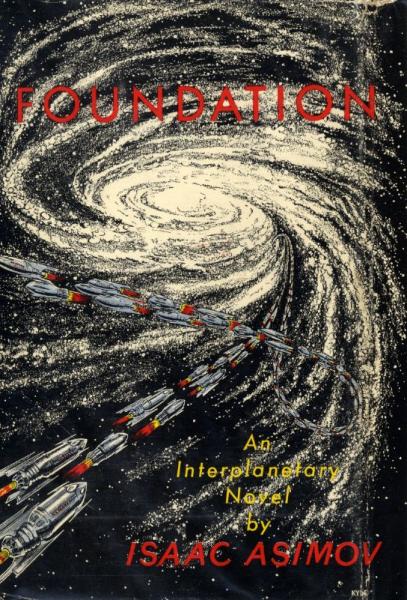
There is a science that reads the future of quadrillions the way an astronomer reads the orbits of stars. It is called psychohistory, and its equations foresee something the ruling Galactic Empire cannot admit: the throne is rotting, and thirty thousand years of barbarism are coming. One man, Hari Seldon, cannot stop the fall. He can only shorten it — by seeding a Foundation of scholars at the rim of the galaxy, a fragile institution built to carry knowledge across the dark and cut the interregnum to a single millennium. This is a universe told in the register of history itself: the long view, the calm of deep time, empires measured in centuries and men measured against them. The spine is Asimov's original trilogy — Foundation, Foundation and Empire, Second Foundation — followed decades later by the sequels Foundation's Edge and Foundation and Earth and the prequels Prelude to Foundation and Forward the Foundation. Late in life Asimov braided this in with his other future histories: the Robot novels of detective Elijah Baley and his humaniform partner R. Daneel Olivaw (The Caves of Steel, The Naked Sun, The Robots of Dawn, Robots and Empire) and the early Galactic Empire novels (Pebble in the Sky and its kin), until one continuous chronicle ran from the first thinking robots to the Second Empire. Other hands extend it — the Second Foundation Trilogy by Gregory Benford, Greg Bear, and David Brin, and shared-world spinoffs such as Robot City — so the corpus sprawls beyond a single author's tidy shelf. What distinguishes it is that the drama is intellectual: crises resolved by insight, nerve, and dialogue rather than fleets and blades, each turn hinging on the hidden logic of the Seldon Plan. Begin where readers have always begun — with Foundation, and the original trilogy in publication order. The rest opens outward from there.
- Salvation
series3 books2018
similar byspacescience fiction+6 more
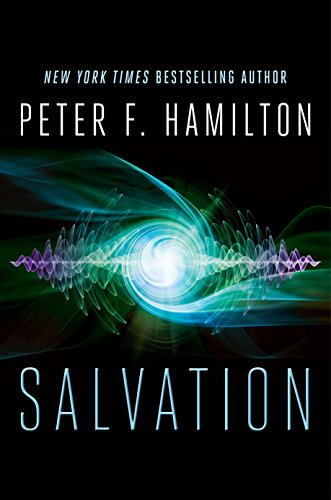
By 2204, instantaneous jump-gate travel has made distance nearly meaningless, connecting Earth to its scattered colonies in a single step -- until a crashed alien ship of unknown origin turns up on a world eighty-nine light years away, carrying something far more dangerous than wreckage. Peter F. Hamilton's Salvation follows the investigation team sent to assess the find, one of whom may not be who they claim, while a second timeline set generations later shows the far-future fallout of what they discover. The trilogy continues through Salvation Lost and The Saints of Salvation.
- The Long Earth
series7 books2012
similar bynear futurescience fictionspace exploration+1 more
Terry Pratchett and Stephen Baxter's Long Earth series (five novels, 2012-2016) begins when a cheap, simple device called a Stepper lets people step sideways into a vast, possibly infinite chain of parallel Earths, none of which developed human civilization. The books follow a natural stepper and an AI that believes itself the reincarnation of a Tibetan repairman as they travel millions of steps out along the chain, encountering other hominid species and the dangers, ecological and social, of an endless open frontier.
- Void Trilogy
series4 books2007
part of Commonwealth Universe
similar byscience fiction+5 more
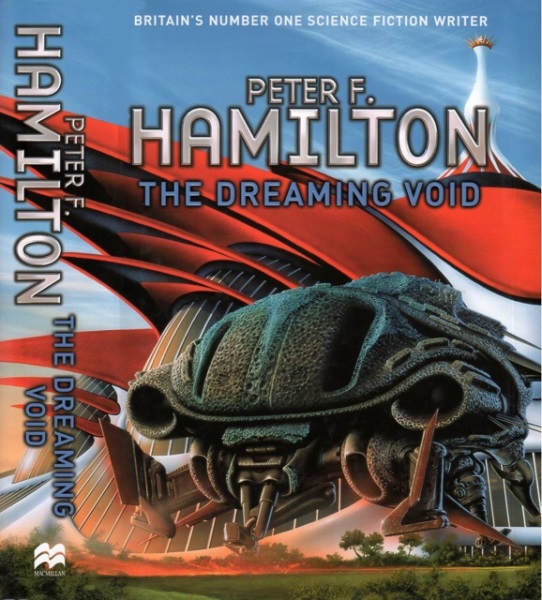
The Void Trilogy is a space opera series by British author Peter F. Hamilton. The series is set in the same universe as The Commonwealth Saga, 1,200 years after the end of Judas Unchained.
- Mission to Methone
Les Johnsonstandalone novel2018
similar bytenseartificial intelligencenear futurespacescience fictionfirst contactaliensspace exploration
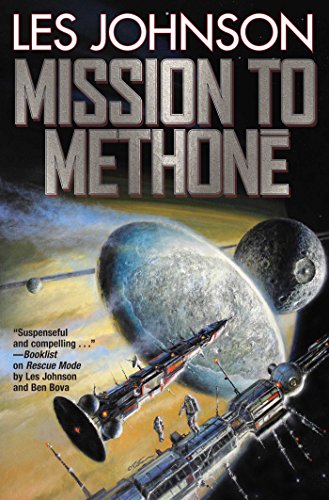
"The year is 2065 and an accidental encounter in space leads to the discovery that we are not alone and that our continued existence may be in jeopardy. Chris Holt, working at the Space Resources Corp., discovers that one of the asteroids he surveying for mining is actually a derelict spaceship. What Earth doesn't know is that across the galaxy, a war has been underway for millennia. A war between alien civilizations that have very different ideas about what should be done about emerging spacefaring civilizations like our own. The artificial intelligence resident in the derelict has been in our solar system since before the dawn of human civilization, watching, waiting and keeping quiet lest the war return and wipe out humanity"--
- Commonwealth Saga
series2 books2004
part of Commonwealth Universe
similar bytensescience fictionaliens+3 more
The Commonwealth Saga is a series of science fiction novels by British science fiction writer Peter F. Hamilton. This saga consists of the novels Pandora's Star (2004) and Judas Unchained (2005). Hamilton has also written several books set in the same literary universe. Misspent Youth (2002) takes place 340 years before the events of Pandora's Star. The Void Trilogy, consisting of The Dreaming Void (2008), The Temporal Void (2009), and The Evolutionary Void (2010), takes place 1,200 years after the events of Judas Unchained; several of the main characters from Judas Unchained and Pandora's Star also appear in the Void trilogy.
- Culture
series15 books1987
completed
part of The Culture
similar byartificial intelligencescience fiction+1 more
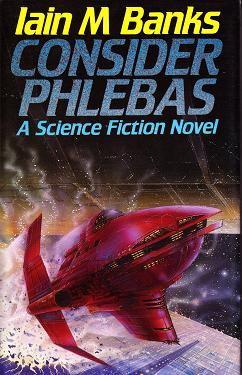
The Culture series is a science fiction series written by Scottish author Iain M. Banks and released from 1987 until 2012. The stories centre on The Culture, a utopian, post-scarcity space society of humanoid aliens and advanced superintelligent artificial intelligences living in artificial habitats spread across the Milky Way galaxy. The main themes of the series are the dilemmas that an idealistic, more-advanced civilization faces in dealing with smaller, less-advanced civilizations that do not share its ideals, and whose behaviour it sometimes finds barbaric. In some of the stories, action takes place mainly in non-Culture environments, and the leading characters are often on the fringes of the Culture, sometimes acting as agents of the Culture in its plans to civilize the galaxy. Each novel is a self-contained story with new characters, although reference is occasionally made to the events of previous novels.
- The Lightspeed Trilogy
series4 books2016
similar byspacescience fiction+4 more
Ken MacLeod's recent trilogy imagines the accidental discovery of faster-than-light travel by a present-day physicist and the political fallout once humanity gets access to a wider galaxy that turns out not to be empty. Beyond the Hallowed Sky opens on an Earth still riven by bloc politics as the discovery becomes a new front in great-power rivalry, with the sequels carrying the consequences off-world. It treats first contact as a geopolitical problem as much as a scientific one.
- Heechee
series19 books1972
completed
similar byspacescience fictionaliensspace exploration
The Heechee Saga, also known as the Gateway series, is a series of science fiction novels and short stories by Frederik Pohl. The Heechee are an advanced alien race that visited the Solar System hundreds of millennia ago and then mysteriously disappeared. They left behind bases containing artifacts, including working starships, which are discovered and exploited by humanity.
- All Judgment Fled
James Whitestandalone novel1968
similar bytensenear futurespacescience fictionfirst contactaliensspace exploration
From the front flap of the Rapp first edition: It is the spring of 1978 and a gigantic alien spaceship has entered the solar system and taken up an orbit some sixty million miles from the Sun. The Ship neither signals nor replies in any detectable fashion to signals directed towards it. Silently and, some think, implacably, it orbits like some tremendous battleship cruising off the coast of a tiny, backward island. Inevitably there are natives on the island whose curiosity outweighs their fear and six men in two tiny sophisticated dug-out canoes go out to satisfy their curiosity... All Judgment Fled is not another story about super heroes solving alien communications problems with the aid of super scientific and infallible translation devices. Instead it concerns the reactions of six very ordinary people to what is probably the most extraordinary situation of all - the first meeting with an extraterrestrial race.
- The Rapture Effect
Jeffrey A. Carverstandalone novel1987
similar bytensespacescience fictionfirst contactaliens+1 more
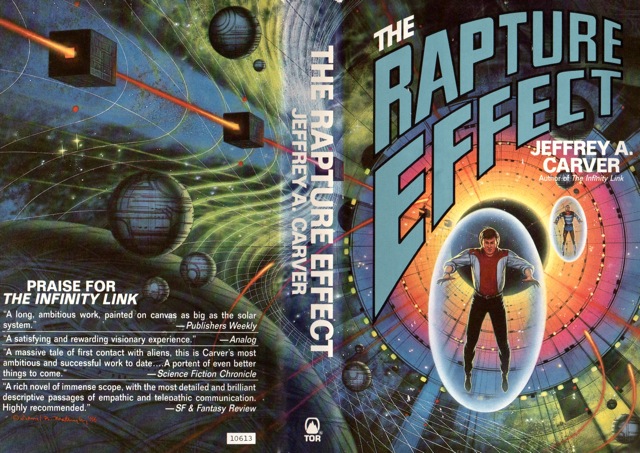
The Rapture Effect is a novel by Jeffrey A. Carver published by Tor Books in 1987.
- Sprawl Trilogy
series10 books1981
similar bytenseartificial intelligencenear futurescience fiction
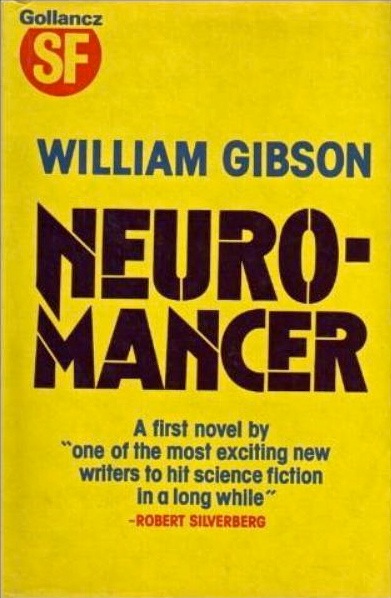
The Sprawl Trilogy is William Gibson's foundational cyberpunk sequence: Neuromancer (1984), in which hacker Case is drawn into a high-stakes heist alongside an artificial intelligence and a damaged ex-soldier, followed by Count Zero (1986) and Mona Lisa Overdrive (1988), which widen the same near-future world of corporate power and networked cyberspace to new characters. Johnny Mnemonic, an early short story set in the same fictional milieu, predates the novels and introduces the courier Molly Millions before her role in the trilogy. Together these works established much of cyberpunk's visual and thematic vocabulary.
- Time Odyssey
series3 books2003
similar byspacescience fictionaliens+3 more
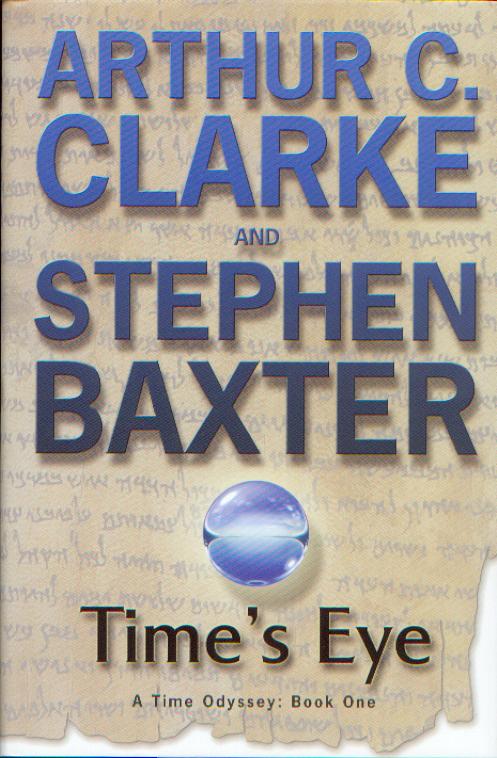
A Time Odyssey is a trilogy of science fiction novels co-written by Arthur C. Clarke and Stephen Baxter. As of 2008, the series consists of:Vol. 1 – Time's Eye Vol. 2 – Sunstorm Vol. 3 – Firstborn