More like Stormrage
anchored on:epic fantasyquestssecondary worldadventurousdarkfantasy
but
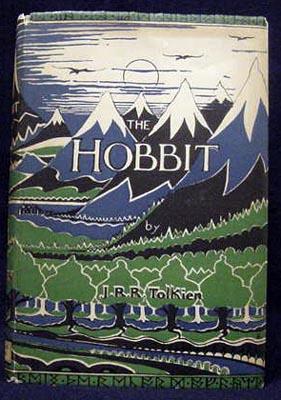
- The Hobbit
series2 books1937
completed
part of Tolkien's legendarium
similar byquestssecondary worldadventurousfantasyepic fantasy
The Hobbit (1937) is J. R. R. Tolkien's children's fantasy novel following the reluctant burglar Bilbo Baggins, who joins a company of dwarves and the wizard Gandalf on a journey to reclaim treasure guarded by the dragon Smaug. It stands as a complete adventure on its own, but shares its setting with the rest of Tolkien's legendarium and leads into the events of The Lord of the Rings.
- The Well at the World's End
William Morrisstandalone novel1896
similar byquestssecondary worldepic fantasyadventurousfantasy
The Well at the World's End is a high fantasy novel by the British textile designer, poet, and author William Morris. It was first published in 1896 and has been reprinted repeatedly since, most notably in two parts as the 20th and 21st volumes of the Ballantine Adult Fantasy series, in August and September 1970.
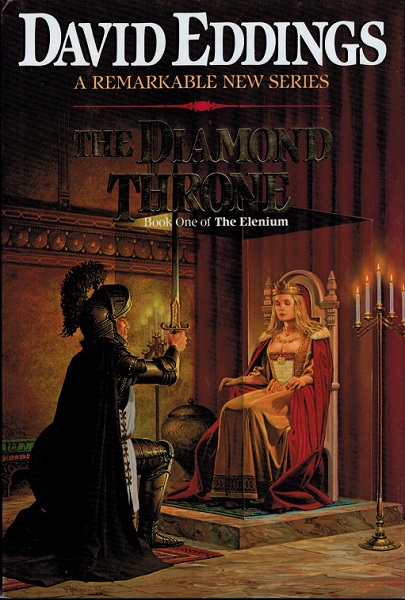
- Elenium
series3 books1989
completed
part of Sparhawk
similar byquestssecondary worldepic fantasyadventurousfantasy
The Elenium is a series of fantasy novels by American writer David Eddings. The series consists of three volumes: The Diamond Throne, The Ruby Knight, and The Sapphire Rose. The series is followed by The Tamuli. The Elenium is Eddings' third fantasy series.
- The Lord of the Rings
series13 books1954
part of Tolkien's legendarium
similar bysecondary worldepic fantasy+3 more
The Lord of the Rings is an epic high fantasy novel written by the English author and scholar J. R. R. Tolkien. Set in Middle-earth, the story began as a sequel to Tolkien's 1937 children's book The Hobbit but eventually developed into a much larger work. Written in stages between 1937 and 1949, The Lord of the Rings is one of the best-selling books ever written, with over 150 million copies sold.
- Thomas Covenant the Unbeliever
series11 books1977
similar byquestssecondary worldepic fantasydarkfantasy
The Chronicles of Thomas Covenant is a series of ten high fantasy novels written by American author Stephen R. Donaldson. The series began as a trilogy, The Chronicles of Thomas Covenant the Unbeliever. This was followed by another trilogy, The Second Chronicles of Thomas Covenant, and finally a tetralogy, The Last Chronicles of Thomas Covenant.
- The Quest of the Riddle-Master
series3 books1976
completed
similar byquestssecondary worldadventurousfantasyepic fantasy
Patricia A. McKillip's Riddle-Master trilogy follows Morgon, prince of the small island of Hed, whose discovery of three star-shaped birthmarks on his forehead draws him into a search for his own hidden identity and a confrontation with ancient, shape-shifting powers. Drawing on Celtic myth, the three books are prized for their lyrical prose and riddle-based magic, and are often cited among the best high fantasy of the 1970s.
- Sparhawk
universe6 books1989
Start hereElenium · Start here
similar byquestssecondary worldepic fantasyadventurousfantasy
Sir Sparhawk is not a young man, and he has little patience for the pageantry his order pretends to. A Pandion Knight of the militant Elene Church, he rides home from a long exile to find his kingdom rotten with intrigue and his young queen, Ehlana, poisoned — kept alive only inside a shell of living crystal. To wake her he must find Bhelliom, a jewel with the power to remake the world or unmake it. So begins a long ride across the continent of Eosia. This is warm, character-first epic fantasy from David Eddings, told across two trilogies. The Elenium — The Diamond Throne, The Ruby Knight, The Sapphire Rose — pits Sparhawk against a corrupt church and a hungry elder god. The Tamuli — Domes of Fire, The Shining Ones, The Hidden City — carries him east into the vast Tamul Empire, where older enemies stir. Around him gathers a quarrelsome company: the Styric sorceress Sephrenia, the thief-boy Talen, the plain-spoken squire Kurik, and a small, imperious goddess who plays a set of pipes and always, somehow, gets her way. The pleasure here is the talk — grizzled knights trading dry insults between miracles and murders, a hero who solves as many problems with patience as with a sword. It never reaches for grimness or grand obscurity; it wants your good company for a long journey. Newcomers begin with The Diamond Throne and read the six in order: the Elenium stands whole on its own before the Tamuli widens the map.
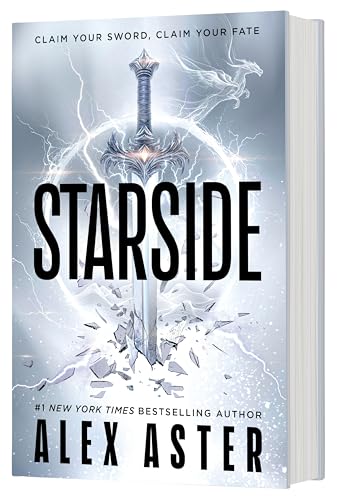
- Starside
Alex Asterstandalone novel2026
similar byquestssecondary worldepic fantasyadventurousdarkfantasy
Hundreds of years ago, a brutal war split a land in two. Starside is the realm of magic and immortals—the descendants of the gods, living in a power-rich paradise. Stormside is where mortals fight for scraps of that magic. Every fifty years, the gates between them open, and fifty challengers are allowed to journey across Starside on a deadly quest to access a pool of magic that can heal, grant wealth, or extend life. Everyone has their reasons for entering, but Aris has only vengeance. As a child, a goddess set fire to her village, killing her family. Aris isn’t after the gods’ magic—she’s going to kill them. First, she must survive the Culling, the king’s deadly competition to choose his fifty challengers. An orphaned blacksmith’s apprentice, Aris doesn’t have the superior weapons of the heirs from the Great Houses. But the greatest swords—ones that contain power—are not inherited or bought, they are claimed, by both sides. And when Aris claims a great sword, it makes her not just a real competitor—but a target. Getting past the gates is only the beginning. Starside is deadlier than it seems. If the ancient creatures, magic-wielding beasts, and bloodthirsty immortals weren’t dangerous enough, a new peril has even immortals fearing what rises from the ground at night. With a blade most would kill to claim, Aris can’t trust anyone. Especially not Harlan Raker, the merciless and mysterious king’s guard who betrayed her years ago—and who may now be the key to her survival. But Aris is hiding a secret tied to her family’s death. And when it’s revealed, not even the gods will be able to stop what’s coming…
- Spiderlight
Adrian Tchaikovskystandalone novel2016
similar byquestssecondary worldepic fantasyadventurousdarkfantasy
Spiderlight is a 2013 fantasy novel by Adrian Tchaikovsky. The novel tells the story of a group of humans and a giant spider who follow a prophecy to defeat the Dark Lord. The novel received critical praise for its exploration of the meaning of good and evil through the use of common fantasy tropes.
- The Crescent Moon Kingdoms
series1 book2012
similar byquestssecondary worldepic fantasyadventurousfantasy+1 more
Saladin Ahmed's The Crescent Moon Kingdoms opens with Throne of the Crescent Moon, set in a realm of djenn and ghuls where a power struggle between an iron-fisted Khalif and a mysterious master thief called the Falcon Prince erupts alongside a series of brutal, supernatural murders. A handful of reluctant heroes must uncover the truth behind the killings before the kingdom tears itself apart.
- Corum
series6 books1971
part of Moorcock's Multiverse
similar bysecondary worldepic fantasyadventurousfantasy+2 more
- The White Mists of Power
Kristine Kathryn Ruschstandalone novel1991
similar byquestssecondary worldadventurousepic fantasyfantasy
Synopsis -An innocent excited boy, a prince and heir, takes his first journey to the city. It is like nothing he imagined. Hands pound against his carriage: voices call for a coin, Sir just one, spare me some money, sir, I haven’t eaten in days. The streets teem with merchants in velvet robes, magicians, half mad preachers, with life and colour and noise. He doesn’t want to miss any of it. But it is the last journey of his life as a prince. Soon he will be abandoned and declared dead. Soon with survival and what will be the driving force of his life: the quest to recover his stolen inheritance, his usurped throne. His home. A story of cities and palaces, of power hungry lords and ladies scheming inside a magically threatened land...Intricate, compelling.
- The Princess and the Goblin
series2 books1871
completed
similar byquestssecondary worldadventurousfantasy
- Redwall
series22 books1986
completed
part of Redwall Universe
similar byquestssecondary worldadventurousfantasy
Redwall is Brian Jacques's long-running series of fantasy novels for young readers, set within the redwall-universe of Redwall Abbey and its community of anthropomorphic animals. It opened in 1986 with the mouse Matthias searching for the lost sword of the legendary Martin the Warrior to defend the abbey from the invading rat Cluny the Scourge, and grew across 22 largely stand-alone novels published through 2011, each set in a different generation of the abbey's history and following its mice, otters, badgers, and vermin adversaries.
- Poison
Chris Woodingstandalone novel2003
similar byquestssecondary worldadventurousdarkfantasy
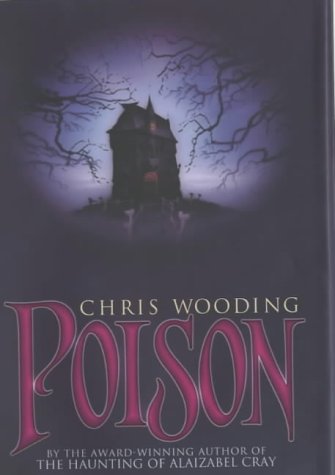
Poison (2003) is a young adult English-language fantasy novel written by Chris Wooding, published in 2003. It is a highly metafictional novel which follows the adventures of a young (sixteen-year-old) female protagonist named Poison as she attempts to rescue her sister from the Phaerie Realm. It contains many intertextual references particularly to mythology, fairy tales and secondary world fantasy characteristics.
- Shannara
universe50 books1977
Start hereWord and the Void · The very beginning of the timeline
similar byepic fantasysecondary worldfantasy+2 more
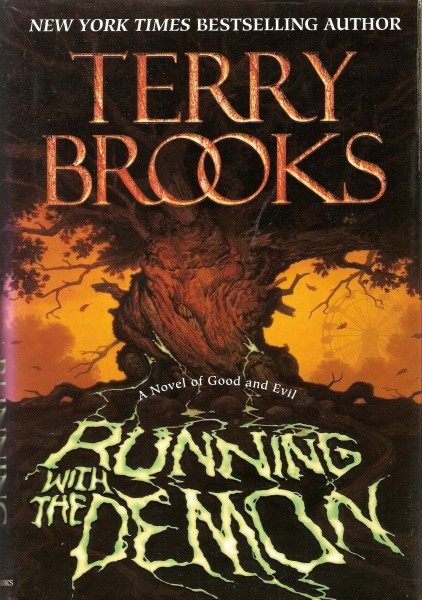
Long after the world we know has burned itself to slag in the Great Wars, the Four Lands rise green over the bones of the old age. Science is a forbidden memory; magic has come back into the world, and with it the old divisions — Men, Elves, Dwarves, Trolls, and Gnomes, each Race a splinter of what humanity became. This is the far-future Earth of Shannara, where the ruins buried beneath the soil are ours, and the only keepers of the vanished knowledge are the Druids of Paranor, who wake once a generation to meet the darkness rising again. Terry Brooks opened the Four Lands in 1977 with The Sword of Shannara and has charted its history for four decades since — a legendarium ordered not by throne but by a single bloodline, the Ohmsfords, each generation inheriting an Elfstone, a blade, or a wishsong when the age demands a hero. The original trilogy gives way to the Heritage of Shannara, the Voyage of the Jerle Shannara, the High Druid, Dark Legacy, Defenders, and the concluding Fall of Shannara; the Genesis of Shannara books reach back to the apocalypse itself, and the Word and the Void trilogy back further still, into a demon-haunted version of our own present that is the root of everything after. In 2025 Brooks passed the histories to Delilah S. Dawson to carry forward. What sets these books apart is their long memory: a world where every triumph is provisional, where the same evil returns wearing a fresh shape each age, and magic always exacts its price. The reading is warm and headlong — questing companies, old talismans, journeys across a mapped and named wilderness — shadowed by the knowledge that all of it stands on the wreckage of a former world. Enter as readers first did: with The Sword of Shannara, then onward in publication order. The chronological path, beginning with Word and the Void, rewards a second journey, once the Four Lands already feel like home.
- The Warrior Who Carried Life
Geoff Rymanstandalone novel1985
similar byquestssecondary worldadventurousdarkepic fantasyfantasy
From the back cover of the Bantam paperback edition: "In a dawn land touched by a strange magic, a young woman burned with a dark vengeance. Barbaric invaders had slaughtered her mother, crippled her father and brother, and left her scarred and barren. To redeem her world from the grip of an ancient Evil, she transformed herself into a mighty warrior, and followed the Road of Heroes into the Land of Death..."
- Narnia
series26 books1950
part of Narnia Universe
similar bysecondary worldadventurousfantasy+2 more
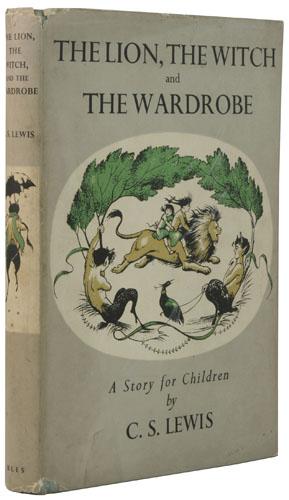
The Chronicles of Narnia is a series of seven portal fantasy novels by British author C. S. Lewis. Illustrated by Pauline Baynes and originally published between 1950 and 1956, the series is set in the fictional realm of Narnia, a fantasy world of magic, mythical beasts, and talking animals. It narrates the adventures of various children who play central roles in the unfolding history of the Narnian world. Except in The Horse and His Boy, the protagonists are all children from the real world who are magically transported to Narnia, where they are sometimes called upon by the lion Aslan to protect Narnia from evil. The books span the entire history of Narnia, from its creation in The Magician's Nephew to its eventual destruction in The Last Battle.
- The Deed of Paksenarrion
series4 books1988
part of Paksenarrion
similar byquestssecondary worldepic fantasyfantasy+1 more
Elizabeth Moon's The Deed of Paksenarrion follows Paksenarrion Dorthansdotter, a sheepfarmer's daughter who leaves home to become a mercenary soldier and, over the course of three novels, a paladin. Grounded in the practical, unglamorous realities of military life before turning toward divine calling, the trilogy was originally published in 1988-89 and later collected as one omnibus. It's known for its grounded approach to fantasy soldiering, informed by Moon's own military background.
- Sovereign Stone
series4 books1999
similar byquestssecondary worldepic fantasyadventurousfantasy+1 more
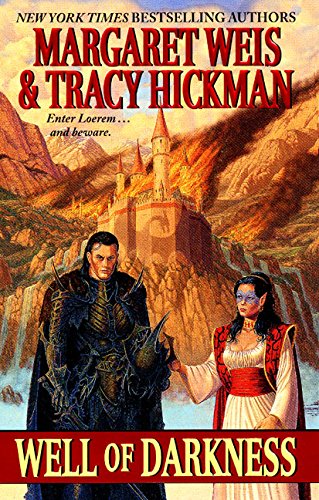
The Sovereign Stone series is a trilogy of fantasy novels: Well of Darkness (2000), Guardians of the Lost (2001), and Journey into the Void (2003), set in the same universe of the Sovereign Stone role-playing game. Both the books and the game were primarily written by Margaret Weis and Tracy Hickman.
- Pellinor
series5 books2002
similar byquestssecondary worldepic fantasyadventurousfantasy
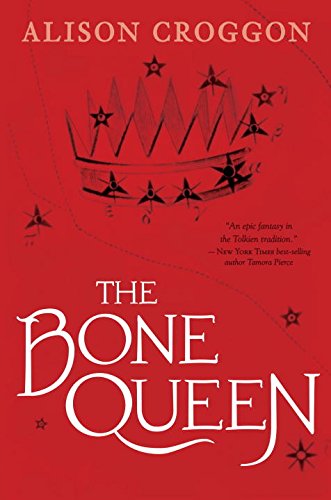
Maerad has spent most of her life enslaved on a remote farm, until the wandering Bard Cadvan recognizes in her the Gift -- a rare and powerful magical ability -- and takes her from captivity into training. Alison Croggon's Books of Pellinor follow Maerad across the world of Edil-Amarandh as she's drawn into a prophecy naming her the only one who might stop the Nameless One, an ancient and corrupting sorcerer, while she also searches for her lost family. The series runs through The Gift, The Riddle, The Crow, The Singing, and the later prequel The Bone Queen.
- Jack of Shadows
series4 books1971
similar byquestssecondary worldadventurousfantasy
Roger Zelazny's Jack of Shadows (1971) is a single novel set on a tidally locked world split between a permanently lit hemisphere ruled by science and a permanently dark one ruled by magic. Its protagonist, Jack of Shadows, draws his power from shadow itself and is nearly helpless in full light or full darkness but formidable wherever shadows fall; the book follows his quest to recover a lost artifact, the Key called Kolwynia, and the power -- and responsibility -- that comes with finding it.
- The Questing Road
Lyn McConchiestandalone novel2010
similar byquestssecondary worldepic fantasyadventurousfantasy+1 more
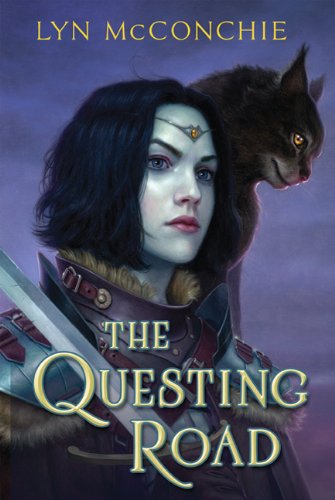
Acolytes to a dark god have crossed the gulf between worlds to abduct an innocent tariling, not even a year old, dooming it to become a sacrifice in a ceremony that will unleash an army of supernatural creatures upon an unsuspecting kingdom. Yoros and Kyrryl know that this is no mere animal, but to its own (felinoid) kind is a cherished child. With their warrior niece, Ashara, they follow its trail through a dimensional gate, little realizing their simple quest will become a desperate fight for survival in the middle of an all-out war. They can't know of the atrocities that decimated the plains tribes of the strange world beyond the gate. Nor can they know of the massive revenge that threatens an entire civilization. If they are to save themselves and their lost tariling, they must follow its magic through the unknown terrors of a bizarre world of alien creatures and mortal perils beyond their wildest imagining.