More like Worldwired
anchored on:science fictionartificial intelligencespacenear futuretensespace opera+4 more
but
- Have Space Suit - Will Travel
Robert A. Heinleinstandalone novel1958
similar bynear futurealiensadventuroustensescience fictionspace operaspace+1 more
From the back cover of the Del Rey 9th printing: "Skyjacked - Everything happened at once. One minute Kip Russell was walking about in his own backyard, testing out an old space suit and dreaming about going to the moon - and the next he was out cold and the captive of an insidious space pirate. The whole thing seemed like a very bad dream until he discovered he wasn't the only prisoner on board. Then the reality of the situation became inescapable. He - along with the daughter of a world-renowned scientist and a beautiful creature from an alien planet - had been skyjacked by a monstrous extraterrestrial and they were on their way to the Moon... a journey toward a fate worse than death!"
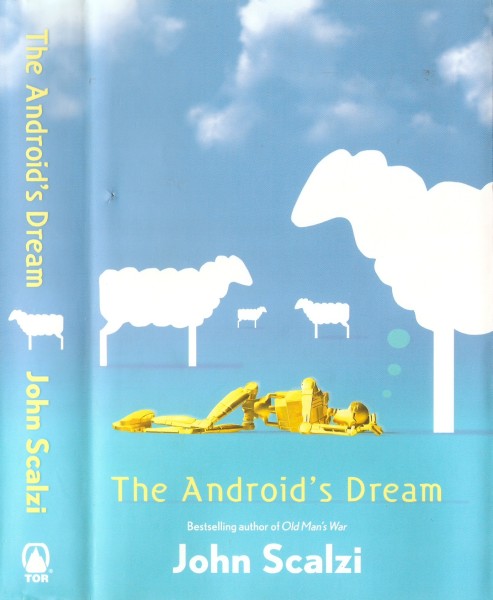
- The Android's Dream
series2 books2006
similar bynear futureartificial intelligencealiensadventurousscience fictionspace operaspace
A minor diplomatic insult with a genetically engineered sheep breed spirals into a full interstellar crisis when the last surviving specimen of the 'Android's Dream' breed, needed for a critical ceremony with the alien Nidu, turns out to have been hunted to extinction by a Nidu faction bent on provoking war. John Scalzi's The Android's Dream follows ex-soldier Harry Creek as the hunt for a replacement leads him to Robin Baker, an ordinary woman carrying hidden sheep DNA that makes her the key to avoiding a war. It's a standalone comic space opera rather than an ongoing series.
- Starplex
Robert J. Sawyerstandalone novel1996
similar bynear futurealienstensescience fictionspacespace operafirst contactspaceship
The only novel of its year to be nominated for both the Hugo and Nebula Awards. Starplex won Canada's Aurora Award for best novel of the year. For nearly twenty years Earth's space exploration had exploded outward, thanks to a series of mysterious, artificial wormholes. No one knows who created these interstellar passages, yet they have brought the far reaches of space immediately close. For Starplex Director Keith Lansing, too close. Discovery is superseding understanding. And when an unknown vessel — with no windows, no seams, and no visible means of propulsion — arrives through a new wormhole, an already battle-scarred Starplex could be the starting point of a new interstellar war . . . ROBERT J. SAWYER has won the Hugo, Nebula, John W. Campbell Memorial, Seiun, and Aurora Awards, all for best science fiction novel of the year. His novels include Hominids, Rollback, Wake, and FlashForward (basis for the TV series).
- Chanur
series7 books1982
part of Alliance-Union Universe
similar byaliensadventuroustensescience fictionspacespace operaspaceship+1 more
The Chanur novels are a series of five science fiction novels, forming three separate stories, written by American author C. J. Cherryh and published by DAW Books between 1982 and 1992. The first novel in the series is The Pride of Chanur (1982), which was nominated for both the Hugo and Locus Awards in 1983. The Pride of Chanur, originally a stand-alone story, was followed by the Chanur's Venture trilogy, Chanur's Venture (1984), which was shortlisted for a Locus Award in 1985; The Kif Strike Back (1985) and Chanur's Homecoming (1986). These were followed by a later sequel, Chanur's Legacy (1992). The five novels were also published in two omnibus editions: the first three in The Chanur Saga in 2000 and the next two in Chanur's Endgame in 2007.
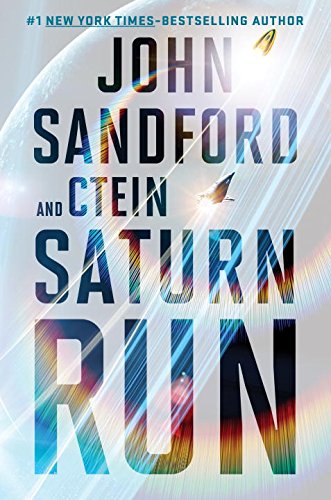
- Saturn Run
Ctein & John Sandfordstandalone novel2015
similar bynear futurealiensadventuroustensescience fictionspacefirst contactspaceship
"The year is 2066. A Caltech intern inadvertently notices an anomaly from a space telescope--something is approaching Saturn, and decelerating. Space objects don't decelerate. Spaceships do. A flurry of top-level government meetings produces the inescapable conclusion: Whatever built that ship is at least one hundred years ahead in hard and soft technology, and whoever can get their hands on it exclusively and bring it back will have an advantage so large, no other nation can compete. A conclusion the Chinese definitely agree with when they find out. The race is on, and a remarkable adventure begins..."--
- Fifth Imperium
series3 books1991
similar byadventuroustensescience fictionartificial intelligencealiensspace operaspace
David Weber's Fifth Imperium series opens with the discovery that Earth's Moon is in fact a disguised alien starship, the Dahak, that has orbited undetected for tens of thousands of years - a relic of the fallen Fourth Imperium, a multi-star civilization destroyed while defending against the genocidal Achuultani. Mutineers' Moon follows humanity's first contact with Dahak and the mutineers still aboard it; The Armageddon Inheritance and Heirs of Empire escalate from that discovery into interstellar war and dynastic politics as humanity inherits the old empire's legacy and its enemies. The three novels were later collected as the omnibus Empire from the Ashes.
- Jenny Casey
series4 books2004
similar bynear futuretensescience fiction+7 more
Elizabeth Bear's Jenny Casey trilogy opens with Hammered (2004), her debut novel, which won the Locus Award for Best First Novel. It continues across Scardown and Worldwired, completing the story of its title character across three volumes published through 2006.
- Moties
series4 books1974
part of CoDominium
similar byaliensscience fictionspace operafirst contactspace+2 more
Larry Niven and Jerry Pournelle's The Mote in God's Eye (1974) depicts humanity's first contact with an alien species, the Moties, set within the far-future interstellar setting of Pournelle's codominium future history. The Gripping Hand continues that first-contact crisis years later, and Outies, written by J. R. Pournelle, carries the story forward into a new generation. Together the three books trace an escalating encounter between human and Motie civilizations within the codominium universe.
- Space Beagle
series5 books1939
completed
similar byaliensscience fictionadventuroustensespacespaceshipspace opera
The Voyage of the Space Beagle is a 1950 fix-up novel by A. E. van Vogt, stitched together from four previously published pulp stories into a single continuous account of the exploration ship Space Beagle's encounters with a series of dangerous alien life forms. Its episodic, crew-versus-monster structure reads as a loose sequence of adventures rather than one continuous plot.
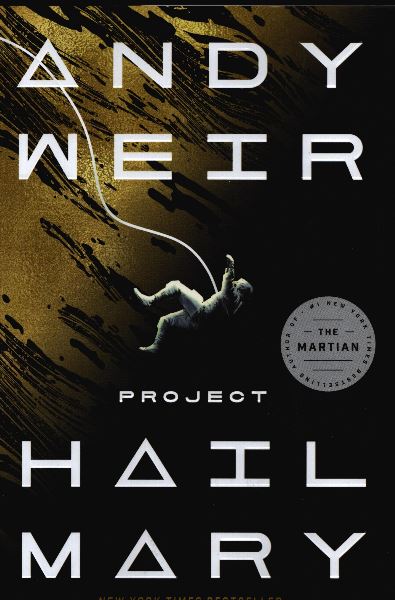
- Project Hail Mary
Andy Weirstandalone novel2021
similar bynear futurealiensadventurousscience fictionfirst contactspaceship
Project Hail Mary is a 2021 hard science fiction novel by American writer Andy Weir. It centers on science teacher and former biologist Ryland Grace, who wakes up aboard a spacecraft, afflicted with amnesia.
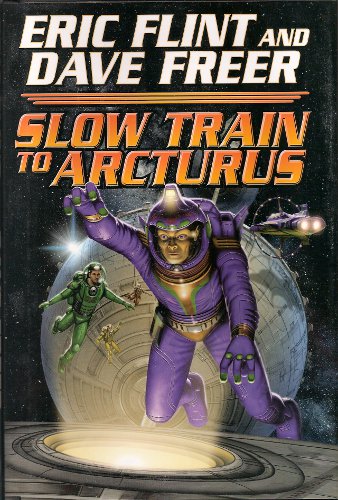
- Slow Train to Arcturus
Eric Flint & Dave Freerstandalone novel2008
similar byaliensadventuroustensescience fictionspace operafirst contactspacespaceship
Sending a spaceship to rendezvous with an enormous vessel made up of a series of globular habitats approaching its star system, the aliens find a savage race calling themselves "humans" who promptly slaughter the exploration team, except for a single survivor who escapes to another habitat, where he finds more friendly humans whose help he requires to get back to his own ship.
- Starstrike
W. Michael Gearstandalone novel1990
similar bynear futurealienstensescience fictionfirst contactspacespaceship+1 more
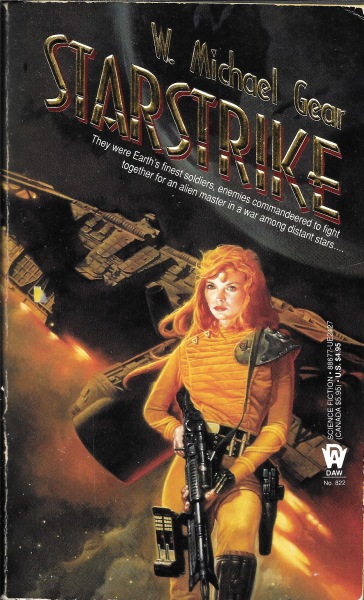
First contact had been an event some humans had dreamed of, others had dreaded, and still others believed would never happen. When it finally did, no one was prepared. For when the Ahimsa came, the course of human destiny was changed in a matter of hours. The alien had contacted Earth against all interstellar regulations. For this "barbaric" world where wars were still very much a part of everyday existence was a forbidden zone for other life-forms in the universe. But the Ahimsa had targeted humans for a mission of its own. And, by taking control of all the Earth's defensive and offensive missile systems, the alien was able to force humans to do its bidding. Soon Earth's most skilled strike force, composed of Soviet, American, and Israeli experts in the arts of war and espionage found themselves aboard an alien vessel, training together for an offensive attack against a distant space station, while fighting their own internal battle to weld people who had been on opposing sides for generations into one unified army. And as they struggled to overcome their own prejudices and hatreds while preparing to face an enemy of unknown capabilities, none of them realized that the greatest danger to humanity's future was right in their midst... (from the back cover of the DAW Books first edition)
- Blindsight / Firefall
series3 books2006
similar byartificial intelligencetensealiensscience fictionfirst contactspace+1 more
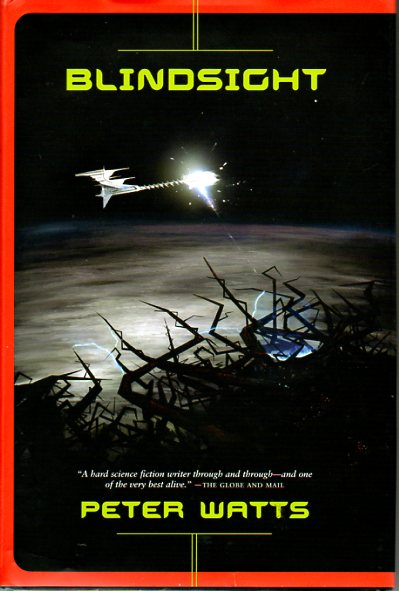
Blindsight sends a crew of radically modified posthumans (including a resurrected, genetically restored vampire) out to the Oort cloud after humanity detects an alien signal, only to make contact with something intelligent, wildly capable, and possibly not conscious at all — a first-contact story built around the question of whether self-awareness is actually useful. Peter Watts's Echopraxia is a same-timeframe "sidequel" rather than a direct sequel, following different characters through the fallout of the same first-contact event.
- Iris
William Barton & Michael Capobiancostandalone novel1990
similar byartificial intelligencealiensadventurousscience fictionspace operafirst contactspace+2 more
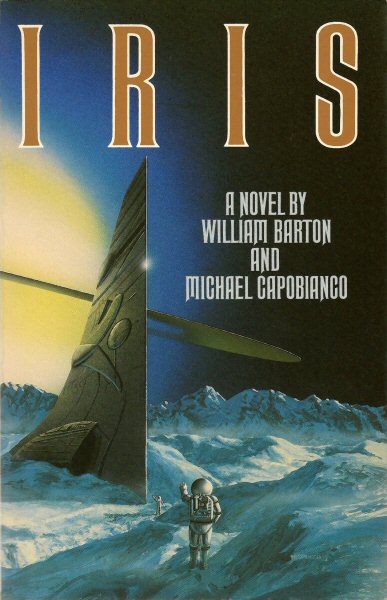
From the front flap of the Doubleday first edition: "From a future Earth ravaged by economic collapse to a rogue planet and its three enigmatic moons, from the familiarity of a colony ship to the heart - and mind - of a totally alien world, William Barton and Michael Capobianco take both the reader and the crew of the Deepstar on a daring odyssey of extraterrestrial exploration and dazzling alien contact. When the gas giant Iris approaches our solar system, the ten-member crew of the Deepstar, originally intending to colonize Titan, decide to change their course and make their new home on Ocypete, one of Iris's moons. It is only when they begin to explore their new surroundings that they discover the Artifact - an ancient alien spacecraft, empty, deserted, but still operational. As the group seeks an explanation for the mysterious ship, they find a frightening new reason to band together when one of their number is suddenly telepathically absorbed by the immense, living alien computer buried at the heart of Iris itself. The discoveries they make - and the battle they must fight - take them on a journey through inner and outer space, through the intricate mazes of the mind and the delicate pathways of the heart."
- Ian Cormac
series6 books2001
part of Polity
similar byartificial intelligencescience fictiontensespacespace opera+2 more
Neal Asher's Ian Cormac novels (Gridlinked, The Line of Polity, Brass Man, Polity Agent, Line War, plus the earlier-set prequel Shadow of the Scorpion) follow Ian Cormac, an agent of Earth Central Security in Asher's Polity universe. Gridlinked opens with Cormac investigating a destroyed matter-transmitter on a remote colony while wrestling with the personality erosion caused by long-term neural linkage to the Polity's AI network; the following novels escalate into interstellar conflict with the alien Prador. Together they form the core action sequence of Asher's wider Polity series.
- The Crimson Deathbringer
series1 book2019
similar bynear futurealiensadventurousscience fictionspace operaspace
- Conquerors
series3 books1994
similar bytensealiensadventurousscience fictionfirst contactspace+1 more
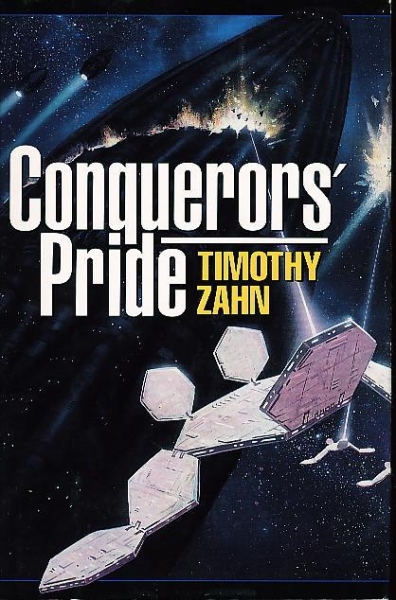
Conquerors is Timothy Zahn's military science-fiction trilogy following human fighter pilots and their commanders through an interstellar war that neither side fully understands, told across Conquerors' Pride, Conquerors' Heritage, and Conquerors' Legacy. Zahn alternates perspective between the human and alien chains of command, using the shifting viewpoints to slowly unpick why the conflict started in the first place. It's contact-and-conflict SF built around miscommunication rather than straightforward invasion.
- All Judgment Fled
James Whitestandalone novel1968
similar bynear futurealienstensescience fictionfirst contactspace+1 more
From the front flap of the Rapp first edition: It is the spring of 1978 and a gigantic alien spaceship has entered the solar system and taken up an orbit some sixty million miles from the Sun. The Ship neither signals nor replies in any detectable fashion to signals directed towards it. Silently and, some think, implacably, it orbits like some tremendous battleship cruising off the coast of a tiny, backward island. Inevitably there are natives on the island whose curiosity outweighs their fear and six men in two tiny sophisticated dug-out canoes go out to satisfy their curiosity... All Judgment Fled is not another story about super heroes solving alien communications problems with the aid of super scientific and infallible translation devices. Instead it concerns the reactions of six very ordinary people to what is probably the most extraordinary situation of all - the first meeting with an extraterrestrial race.
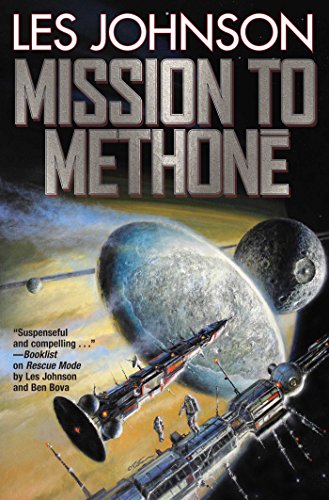
- Mission to Methone
Les Johnsonstandalone novel2018
similar bynear futureartificial intelligencealienstensescience fictionspacefirst contact
"The year is 2065 and an accidental encounter in space leads to the discovery that we are not alone and that our continued existence may be in jeopardy. Chris Holt, working at the Space Resources Corp., discovers that one of the asteroids he surveying for mining is actually a derelict spaceship. What Earth doesn't know is that across the galaxy, a war has been underway for millennia. A war between alien civilizations that have very different ideas about what should be done about emerging spacefaring civilizations like our own. The artificial intelligence resident in the derelict has been in our solar system since before the dawn of human civilization, watching, waiting and keeping quiet lest the war return and wipe out humanity"--
- Eater
Gregory Benfordstandalone novel2000
similar bynear futurealienstensescience fictionfirst contactspace+1 more
From the flaps of the Eos first edition: "Dr. Benjamin Knowlton heads the High Energy Astrophysics Center, a prestigious research facility devoted to the interpretation of astronomical data. He stands at the apex of his profession, respected by his peers and involved in research with the potential to revolutionize our understanding of the universe. But Benjamin has no cause to celebrate. His beloved wife and colleague, Channing, an ex-astronaut turned astronomer, is dying of cancer. She has only a few months to live. Then an anomalous signal from a remote probe alerts Banjamin to the presence of a wandering black hole beyond the orbit of Pluto. Though its trajectory will take it through the solar system, the singularity poses no threat to Earth-on the contrary, it may hold answers to the most fundamental questions of physics. But when an encoded message is received from the black hole, excitement turns to astonishment and apprehension. The thing is alive, intelligent, its mind residing in powerfully fluctuating fields of electromagnetic energies that radiate outward from its infinitely dense core. And it wants a closer look at Earth... and its inhabitants. The entity - dubbed the Eater for its habit of devouring everything in its path - proves eager to share its vast knowledge, accumulated in the course of explorations that began long before life arose on Earth. In exchange, it seeks to learn about human art, culture, and science. The world is charmed by the seemingly beneficent alien. Even Channing is infused with fresh strength and purpose. But gradually a terrifying truth about the singularity emerges - a truth almost too awful to comprehend. Now, as the world waits, Channing volunteers to undertake a desperate gamble: a one-to-one confrontation with the Eater."
- The Star Beast
Robert A. Heinleinstandalone novel1954
similar bynear futurealiensadventurousscience fictionfirst contact+1 more
A talking alien pet has grown to the size of a small dinosaur. She repeatedly gets her teenage owner in trouble whenever she leaves the backyard, but he continues to care for her, as did his father and grandfather before him. When an alien delegation lands on Earth and demands custody, he fights to protect her.
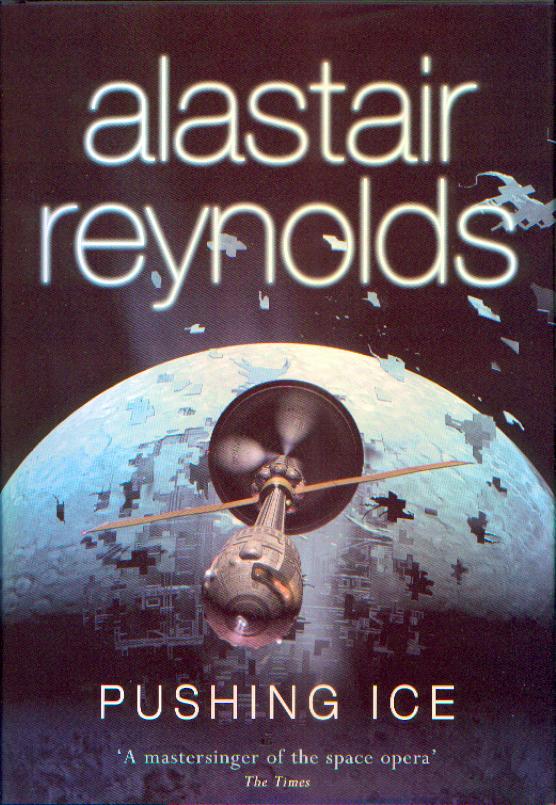
- Pushing Ice
Alastair Reynoldsstandalone novel2005
similar byalienstensescience fictionfirst contactspacespaceship+1 more
When Saturn's moon Janus suddenly takes off into interstellar space, an ice mining spaceship sent to investigate finds itself swept along into distant space until it ends up trapped in a gigantic alien structure, wherein the crew must prepare to reside for the foreseeable future.
- The Wailing Asteroid
Murray Leinsterstandalone novel1960
similar bynear futurealiensadventurousscience fictionfirst contactspace
The Wailing Asteroid is a science-fiction novel written by Murray Leinster and first published in 1960 by Avon Books. It presents the theme of the lone inventor who saves Earth from cosmic danger and introduces humanity to an unknown civilization. The novel was adapted for film by John Brunner as The Terrornauts in 1967.
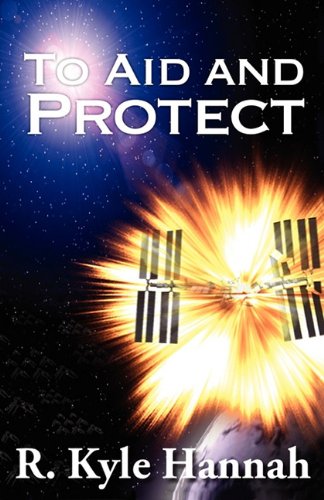
- To Aid and Protect
R. Kyle Hannahstandalone novel2010
similar byartificial intelligencealiensadventurousscience fictionspacespace operafirst contact
● "When their planet faces destruction, the simian-like Cenceti flee in thousands of ships piloted by a master computer designed to watch over and guide them. When a new homeworld is discovered and preparations are made to abandon the fleet, the now sentient computer realizes it cannot assist them if they leave. Now, after years of roaming the universe and unsuccessfully interacting with dozens of species, the computer has picked up signals from another sentient species; a species in desperate need of protection. Following the signals, the computer turns its fleet of spider-shaped ships toward the planet Earth. " ― quoted from this book's Amazon product page as of 2022-06-09.