
The Secret of Sinharat 1964
Open book →
Universe
Leigh Brackett & Ray Bradbury · 10 series · 7 novels · 5 novellas · 13 novelettes · 10 short stories · 4 collections · 1940–2024
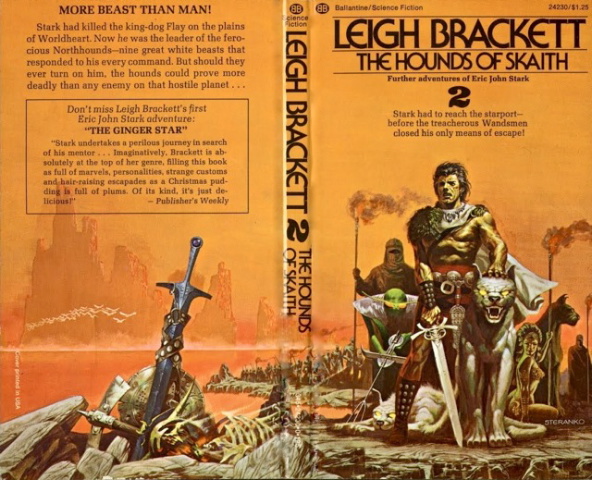
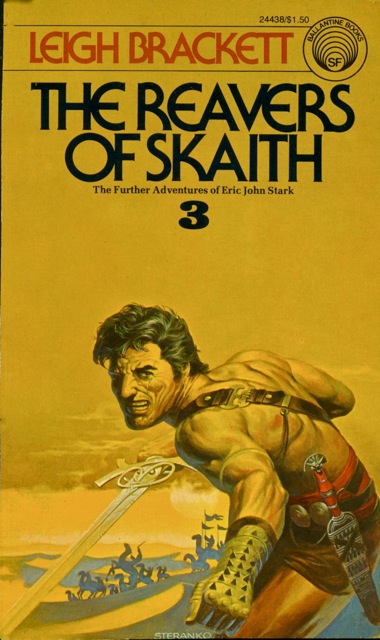
Here is a Solar System that never was and ought to have been: Mars grown ancient and dry, its dead sea-bottoms haunted by walled cities that were old when Earthmen still huddled in caves; Venus a green furnace of swamp and pearl-lit seas; Mercury a standing wall of fire at the edge of the map. Leigh Brackett's worlds are planetary romance at its most sun-scorched — sword and ray-gun both, doom laid heavy over every horizon, and a wanderer walking into it with a killer's patience. The through-line is Eric John Stark, born on Mercury and raised wild by its aboriginal people, an outlaw who turns up wherever a free folk is being ground under a heel. His early adventures range the inner planets — The Secret of Sinharat and People of the Talisman on Mars, "Enchantress of Venus" in its steaming shallows — before the Skaith trilogy (The Ginger Star, The Hounds of Skaith, The Reavers of Skaith) carries him past the Solar System entirely, to a doomed world circling a dying sun. Around Stark the catalog gathers Brackett's other planetary tales — Venus, Mars, the Asteroid Belt, Earth — among them "Lorelei of the Red Mist," begun by Brackett and finished by a young Ray Bradbury. What lingers is the mood: elegiac, gorgeous, hard as flint, nearer a frontier ballad than to hard science fiction. Newcomers do best to start with the Stark Mars stories — The Secret of Sinharat, People of the Talisman — or the standalone The Sword of Rhiannon, then follow Stark outward to Skaith, the one long arc this loose shared world holds. The rest you may wander in any order the red light leads you.
Summary by Loreful, from public sources
One book per branch.
7 novels · 1 novella
✦ Curated by the Loreful team
27 works not in this orderLeigh Brackett's solar system is mostly a shared backdrop for stand-alone pulp adventures across different planets and protagonists. The one continuing story is Eric John Stark's: his 1949 debut and 1951 sequel in their 1964 book expansions, his Venus novella between them, and the closing Skaith trilogy. Her two other Mars novels follow as optional side reads, unconnected to Stark.
Leigh Brackett's Solar System at the centre, 10 branches around it.
What this universe published, when, and what it is made of.
39 works · 1940–2024 · busiest 1941 (5 works) · longest gap 42 years (1977–2018)
Empty columns are silent years — nothing published. The longest silence here is 42 years, 1977–2018.
See every work ↓7 novels · 5 novellas · 13 novelettes · 10 short stories · 4 collections
2 authors · completed universe
reads like:science fictionspace explorationmarsfar futureadventurousadult
Bright and intense: 85% of this universe's placed works, the catalog's 44%.
this universe · the catalog · one dot = one book27 of 39 works carry a tone
Every work, three ways to look at it.
Series and publication data from ISFDB, CC BY 4.0. Branch grouping is derived, not curated.