More like Second Course
anchored on:science fictionspacefar futurefunnyspace operahumor+3 more
but
- Douglas Adams's Starship Titanic
Terry Jonesstandalone novel1997
similar byfar futurerobotsfunnyscience fictionspace operahumorspacespaceship
At the heart of a galaxy of which we know nothing, the greatest, most advanced starship ever known has been built -- the Starship Titanic. It is fabulous, beautiful and technologically miraculous. On its maiden voyage it crashes into hyperspace and vanishes. The first you know of it is when you are sitting at home having a quiet evening in front of the TV and the most fabulous starship in the galaxy crashes into your home. You find your way on board (or not, if you just want to play the two min ute version of the game) and are confronted with an interior which resembles a mixture of the Ritz, the Chrysler Building, Tutankhamen’s tomb, and Venice. The ship is inhabited by traumatized robots, a lobotomized cyberintelligence, a frankly unhinged parrot and, as the ship takes off, taking you deep into unknown interstellar space, you realize that life on board as a third class passenger is going to be tough going. You find yourself in the grip of one of the most powerful forces known to modern man -- the desire for a free upgrade. Your task is to discover what has happened here, to reveal the deep conspiracy that lies behind this catastrophic failure, to repair the ship’s intelligence and guide the ship back home. To do this you will have to gain the trust of the robots, which you do the same way you would with anybody else -- by talking to them. State-of-the-art language technology lets you do this.
- Starman Jones
Robert A. Heinleinstandalone novel1953
similar byfar futureadventurousscience fictionspacespace operaspaceship+1 more
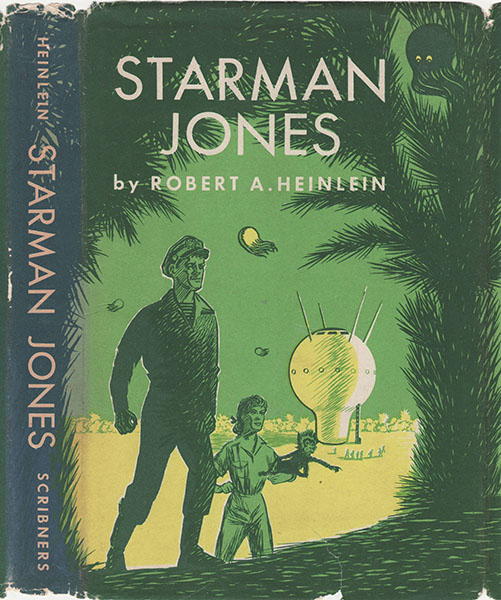
Starman Jones, a 1953 science fiction novel by Robert A. Heinlein, features a farm boy who wants to go to the stars. Charles Scribner's Sons published the book as part of the Heinlein juveniles series.
- Star Smashers of the Galaxy Rangers
Harry Harrisonstandalone novel1973
similar byfar futurefunnyscience fictionspacespace operahumor+2 more
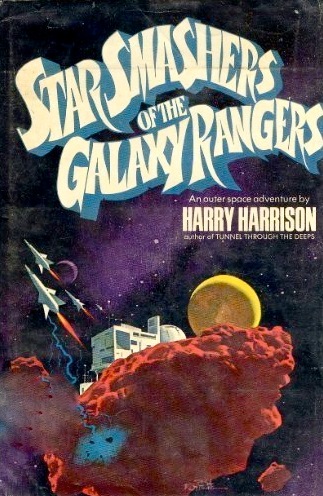
Star Smashers of the Galaxy Rangers is a 1973 comic science fiction novel by American writer Harry Harrison. It is a parody of the space opera genre and in particular, the Lensman and Skylark series of E. E. "Doc" Smith. The main characters are homages to Tom Swift Jr. and his buddy, Bud Barclay. It also includes a homage to Larry Niven's Ringworld (1970).
- The Stainless Steel Rat
series21 books1957
completed
similar byfar futurefunnyadventurousscience fictionspace operaspace+1 more
James Bolivar diGriz, alias "Slippery Jim" and "The Stainless Steel Rat", is a fictional character and a series of comic science fiction novels written by Harry Harrison.
- Hitchhiker's Guide to the Galaxy
series16 books1979
part of The Hitchhiker's Guide to the Galaxy Universe
similar byfar futurescience fictionfunnyspacehumor+2 more
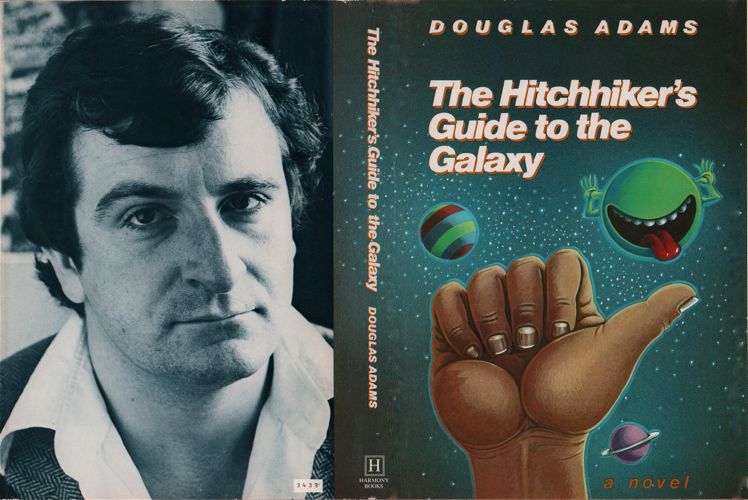
The Hitchhiker's Guide to the Galaxy is a comedy science fiction franchise created by Douglas Adams. Originally a radio sitcom broadcast over two series on BBC Radio 4 between 1978 and 1980, it was soon adapted to other formats, including both novels and comic books, a 1981 BBC television series, a 1984 text adventure game, stage shows and a 2005 feature film.
- The Sirens of Titan
Kurt Vonnegut & Jr.standalone novel1959
similar byfar futurefunnyscience fictionspacealiensspace opera
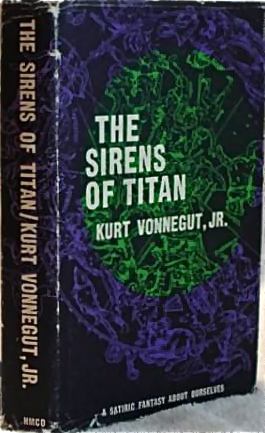
The Sirens of Titan is a comic science fiction novel by Kurt Vonnegut Jr., first published in 1959. His second novel, it involves issues of free will, omniscience, and the overall purpose of human history, with much of the story revolving around a Martian invasion of Earth.
- Ringworld
series5 books1970
part of Known Space
similar byfar futurescience fictionadventurousaliensspace operaspace
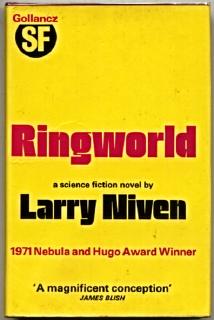
The Ringworld series is a series of science fiction novels written by American author Larry Niven. It is part of his Known Space series of stories. Its backdrop is the Ringworld, a giant artifact 3 million times the surface area of Earth circling a star. The series is composed of four standalone science fiction novels, the original award-winning book and its three sequels:1970: Ringworld 1979: The Ringworld Engineers 1996: The Ringworld Throne 2004: Ringworld's Children
- The Android's Dream
series2 books2006
similar byfunnyadventurousscience fictionaliensspace operahumorspace+1 more
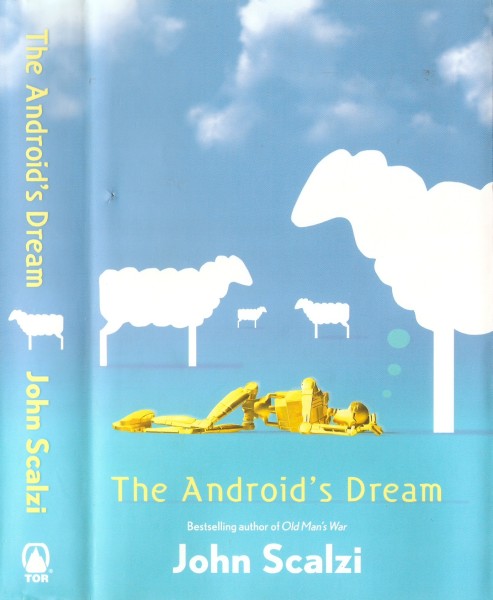
A minor diplomatic insult with a genetically engineered sheep breed spirals into a full interstellar crisis when the last surviving specimen of the 'Android's Dream' breed, needed for a critical ceremony with the alien Nidu, turns out to have been hunted to extinction by a Nidu faction bent on provoking war. John Scalzi's The Android's Dream follows ex-soldier Harry Creek as the hunt for a replacement leads him to Robin Baker, an ordinary woman carrying hidden sheep DNA that makes her the key to avoiding a war. It's a standalone comic space opera rather than an ongoing series.
- Chanur
series7 books1982
part of Alliance-Union Universe
similar byfar futureadventurousscience fictionaliensspacespace operaspaceship
The Chanur novels are a series of five science fiction novels, forming three separate stories, written by American author C. J. Cherryh and published by DAW Books between 1982 and 1992. The first novel in the series is The Pride of Chanur (1982), which was nominated for both the Hugo and Locus Awards in 1983. The Pride of Chanur, originally a stand-alone story, was followed by the Chanur's Venture trilogy, Chanur's Venture (1984), which was shortlisted for a Locus Award in 1985; The Kif Strike Back (1985) and Chanur's Homecoming (1986). These were followed by a later sequel, Chanur's Legacy (1992). The five novels were also published in two omnibus editions: the first three in The Chanur Saga in 2000 and the next two in Chanur's Endgame in 2007.
- Space Beagle
series5 books1939
completed
similar byfar futurescience fictionadventurousaliensspacespaceshipspace opera
The Voyage of the Space Beagle is a 1950 fix-up novel by A. E. van Vogt, stitched together from four previously published pulp stories into a single continuous account of the exploration ship Space Beagle's encounters with a series of dangerous alien life forms. Its episodic, crew-versus-monster structure reads as a loose sequence of adventures rather than one continuous plot.
- Nova
Samuel R. Delanystandalone novel1968
similar byfar futureadventurousscience fictionspacespace opera+1 more
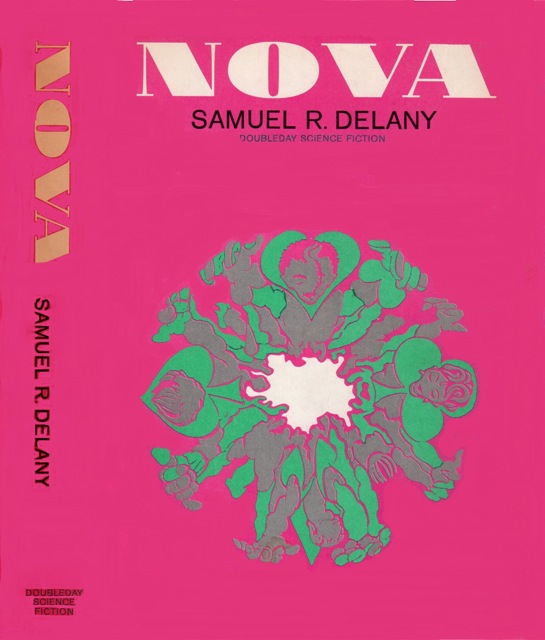
Nоva is a science fiction novel by American writer Samuel R. Delany published in 1968. The plot concerns the spaceship captain Lorq Von Ray's search for a nova, which will produce the essential power source Illyrion, and his vendetta with the Red family, who seek to kill him. Nominally space opera, it explores the politics and culture of a future where cyborg technology is universal, yet making major decisions can involve using tarot cards. It has strong mythological overtones, relating to both the Grail Quest and Jason's quest for the Golden Fleece.
- The Race for God
Brian Herbertstandalone novel1990
similar byfar futureadventurousfunnyscience fictionspacealiensspace operaspaceship
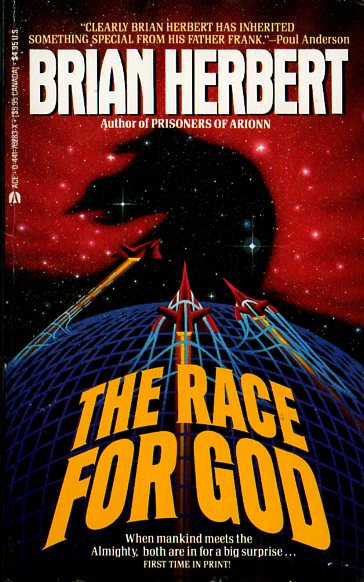
God, it turns out, lives on the planet Tananius-Ofo in the distant galaxy 722C12009. And now, after countless millennia, He's invited us to come visit Him. Not everybody, mind you. Just an odd assortment of heathens, heriticts, pantheists, perverts and true believers of every sect and creed - all crammed into a single white spaceship piloted by a slightly crazed bio-computer. Each pilgrim is determined to be the first to reach God and learn His secrets... if they don't all kill each other on the way there.First time in trade paperback, from the international best-selling author of the Dune books!
- Moties
series4 books1974
part of CoDominium
similar byfar futurescience fictionaliensspace operaspace+1 more
Larry Niven and Jerry Pournelle's The Mote in God's Eye (1974) depicts humanity's first contact with an alien species, the Moties, set within the far-future interstellar setting of Pournelle's codominium future history. The Gripping Hand continues that first-contact crisis years later, and Outies, written by J. R. Pournelle, carries the story forward into a new generation. Together the three books trace an escalating encounter between human and Motie civilizations within the codominium universe.
- Dramocles: An Intergalactic Soap Opera
Robert Sheckleystandalone novel1983
similar byfar futurefunnyadventurousscience fictionspacespace operahumor
Dramocles: An Intergalactic Soap Opera is a science fiction novel by American writer Robert Sheckley, published in 1983.
- Phule's Company
series6 books1990
similar byfar futurefunnyscience fictionhumorspace+1 more
Phule's Company is a series of comic military science fiction novels by Robert Asprin, beginning with Phule's Company and ending with Phule's Errand.
- Berserker (Fred Saberhagen)
series59 books1963
similar byfar futurerobotsscience fictionspacespace opera
The Berserker series is a series of space opera science fiction short stories and novels by Fred Saberhagen, in which robotic self-replicating machines strive to destroy all life.
- The Kruton Interface
John DeChanciestandalone novel1993
similar byfar futurefunnyscience fictionaliensspace operahumorspacespaceship+1 more
Think you're spaced out? Climb aboard the U.S.S. Repulse... Captain David Wanker thought his career had hit rock bottom. The he was assigned to the Repulse... It's the lowest-rated ship in the Space Forces. The navigator get lost. The engineer is incomprehensible. Security can't stay awake. And the doctor needs medication. But... When an army of alien lawyers sues the entire human race, only this captain and this crew can save humanity from terminal litigation. The repulsive adventures begin! God help us all. (from the back cover of the Ace Books first edition)
- Uplift Universe
universe13 books1980
Start hereUplift · Start here
similar byfar futurescience fictionadventurousaliensspacespace opera
No species, the Galactics insist, ever climbs to sapience alone. For a billion years the elder races have "uplifted" their chosen clients — reshaping some promising animal, gene by patient gene, into a thinking being, then binding it through long ages of indenture. Patron lifts client; client one day becomes patron; and every lineage traces back through the vast Galactic Library to the vanished Progenitors who began it all. Then a ragged band of primates arrives at the stars with no patron to claim them — wolflings, self-made, an affront to a hundred thousand years of law — and worse, these humans have already started uplifting neighbors of their own: the neo-dolphins and neo-chimpanzees of Earthclan. David Brin builds this galaxy across two trilogies. The first — Sundiver, the Hugo- and Nebula-winning Startide Rising, and the Hugo-winning The Uplift War — sends an expedition into the Sun, then follows the dolphin-crewed survey ship Streaker as it flees a discovery that sets fanatical star-clans at war, and a chimp-led resistance on an invaded colony world. The second sequence, Uplift Storm — Brightness Reef, Infinity's Shore, Heaven's Reach — descends to Jijo, a forbidden world where six fallen races hide as illegal settlers, and draws every loose thread toward a reckoning. Short fiction fills the margins. This is space opera with an ecologist's conscience: teeming with invented biologies, wry cross-species banter, and real unease about what we owe the minds we make. Begin with Startide Rising — the saga's beating heart, and readable on its own — or take Sundiver first and read straight through in publication order.
- Pip & Flinx
series18 books1972
part of Humanx Commonwealth
similar byfar futureadventurousscience fictionaliensspace operaspace
The Pip & Flinx novels follow Flinx, a young man with an unusual, mysterious origin, and his ever-present animal companion Pip, across Alan Dean Foster's Humanx Commonwealth setting. Beginning with The Tar-Aiym Krang (1972) — chronologically the second entry, since Foster later filled in Flinx's earlier life — the series grew to fifteen novels published between 1972 and 2017, mixing planetary adventure with a slowly unfolding personal mystery.
- Old Man's War
series16 books2005
similar byfar futurescience fictionadventurousspacespace opera+1 more
The Old Man's War series is a series of science fiction novels by John Scalzi. The first book in the series, Old Man's War, was first published in 2005 by Tor Books, and was nominated for the Hugo Award for Best Novel in 2006. In 2026 it was a finalist for the Hugo Award for Best Series.
- Redshirts
John Scalzistandalone novel2012
similar byfar futurefunnyscience fictionspace operaspacespaceship
Redshirts is a postmodernist science fiction novel by John Scalzi that satirizes the tropes and narrative elements of Star Trek from the perspectives of several characters in a fictional TV show about the adventures of a starship and its crew who gradually become aware of their true nature.
- Starship Troopers
Robert A. Heinleinstandalone novel1959
similar byfar futureadventurousspacealiensscience fiction+1 more
Starship Troopers is a military science fiction novel by American writer Robert A. Heinlein. Written in a few weeks in reaction to the US suspending nuclear tests, the story was first published as a two-part serial in The Magazine of Fantasy & Science Fiction as Starship Soldier, and published as a book by G. P. Putnam's Sons on November 5, 1959.
- Mindswap
Robert Sheckleystandalone novel1966
similar byfar futureadventurousfunnyscience fictionaliensspace
"In the future, interstellar travel to alien worlds will be too expensive for most ordinary people. It certainly is for Marvin, a college student who wants to take a really good vacation. And so he signs up for what he can afford, a mindswap, in which a persons consciousness is swapped into the body of an alien lifeform. But Marvin is unlucky, and finds himself in the body of an interstellar criminal, a body that he has to vacate fast. But that criminal consciousness has stolen Marvins earthly body, and Marvin has to find a body on the black market. Travel from world to world with Marvin, each one crazier than the last, as he keeps finding far-from-ideal bodies in awful situations, just to stay alive"--Cover p. [4].
- Ian Cormac
series6 books2001
part of Polity
similar byfar futurescience fictionspacespace opera+2 more
Neal Asher's Ian Cormac novels (Gridlinked, The Line of Polity, Brass Man, Polity Agent, Line War, plus the earlier-set prequel Shadow of the Scorpion) follow Ian Cormac, an agent of Earth Central Security in Asher's Polity universe. Gridlinked opens with Cormac investigating a destroyed matter-transmitter on a remote colony while wrestling with the personality erosion caused by long-term neural linkage to the Polity's AI network; the following novels escalate into interstellar conflict with the alien Prador. Together they form the core action sequence of Asher's wider Polity series.